Savings Challenges
11 Free Printable Savings Challenges (PDF)
Pick from 11 free printable savings challenges, from a $500 mini sheet to $10,000. Color in a box each time you save. Instant download, no email.
A savings challenge is a simple plan that tells you how much to save and when, usually on a printed sheet with boxes you color in as you go. A savings challenge printable is that sheet as a free PDF. Print one, save the amount in a box, color it in, repeat. Below are eleven of them, from a $500 starter sheet up to $10,000.
Quick picks
- Never done one before: Mini $500
- Money is tight: Penny Challenge
- Paid every two weeks: 26 Week
- A big goal: $10,000
- You want it to be fun: 100 Envelope
- You have quit one before: Flexible
Every sheet below is a free PDF. No email, no account, and the exact total is printed on the page so you always know what a full sheet is worth.
What is a savings challenge?
A savings challenge gives your saving a shape. Instead of “I should put more away this month,” you get something specific: save this amount, this often, until the sheet is full.
Most work in one of three ways.
- By week. A set amount each week. The 52 week challenge is the one most people have heard of.
- By amount. You are aiming at a number, like $1,000 or $5,000, and you fill in boxes until you reach it. There is no deadline.
- By chance. You pull a number at random and save whatever it says. The 100 envelope challenge works this way.
None of them are clever, and none of them create money you do not have. What they do is make progress visible. A number inside a banking app is easy to ignore. Forty colored boxes on the refrigerator door are not.
It is also a reasonable thing to be working on. In its 2025 survey, the Federal Reserve found that 55 percent of adults had money set aside for three months of expenses, which means nearly half did not.
How to use these printable savings challenges
- Pick one challenge, not four. The most common reason a money saving challenge stalls is running several at once. One sheet, one goal.
- Print the page. Every sheet is US Letter, 8.5 x 11 inches, and prints on A4 if you choose “fit to page” in your printer settings. All of them are black and white with plenty of space, so they stay light on ink.
- Set a start date. Write it in the box at the bottom. A challenge with a start date is a plan; without one it is an intention.
- Color in a box each time you save. Same color throughout if you like the look, or a new color each month so you can see your pace.
- Keep the money somewhere safe. Anywhere that is not your everyday checking account. A separate savings account with no debit card works, and so does a cash envelope in a drawer.
- Track the running total. Use the “Saved so far” line at the bottom so you always know where you are without opening anything.
The tracker is a reminder, not a rulebook. Miss a week and you color the box in late.
All 11 free savings challenge printables
Each one shows what it is, the exact total, how many boxes, how long it takes and who it suits. Tap a preview to see the full sheet before you download it.
52 Week Savings Challenge
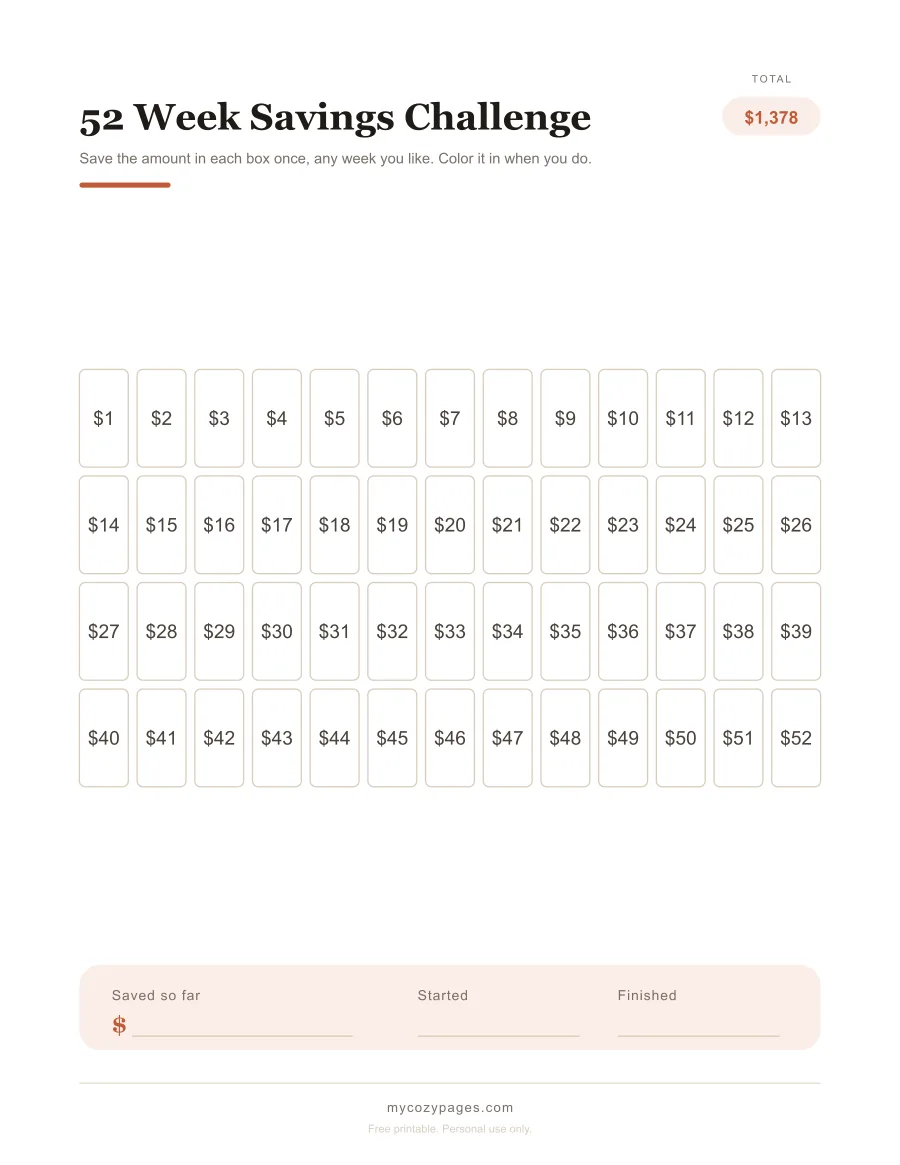
The one most people start with. Week one you put away $1, week two $2, and so on up to $52 in the final week. There are nine versions of this one, including a dated 2027 chart and a biweekly version.
- Total saved
- $1,378
- Boxes to fill
- 52
- How long it takes
- 1 year
- Best for
- A steady weekly habit
Reverse 52 Week Savings Challenge
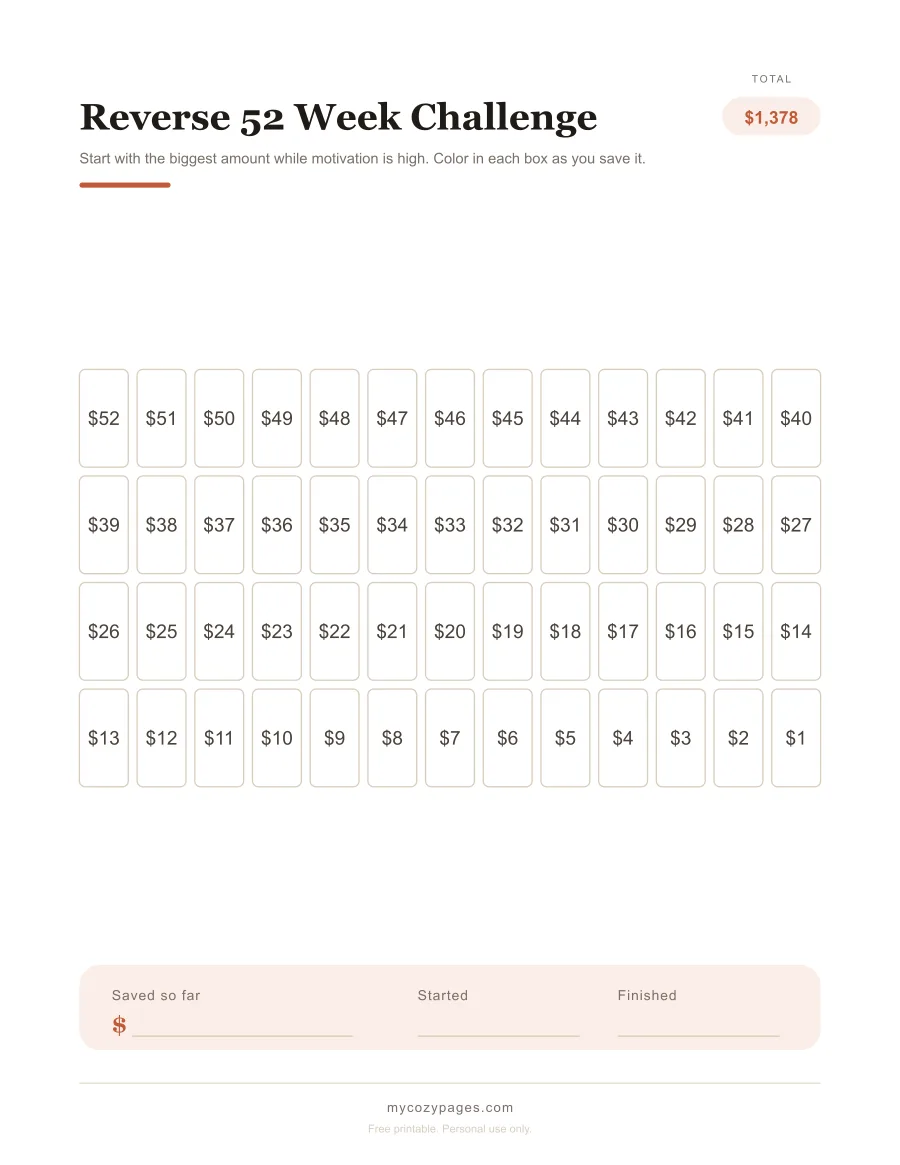
The same total as the standard version, flipped. You save $52 in week one and finish with $1, so the hardest weeks are behind you early.
- Total saved
- $1,378
- Boxes to fill
- 52
- How long it takes
- 1 year
- Best for
- Saving more early in the year
26 Week (Bi-Weekly) Savings Challenge
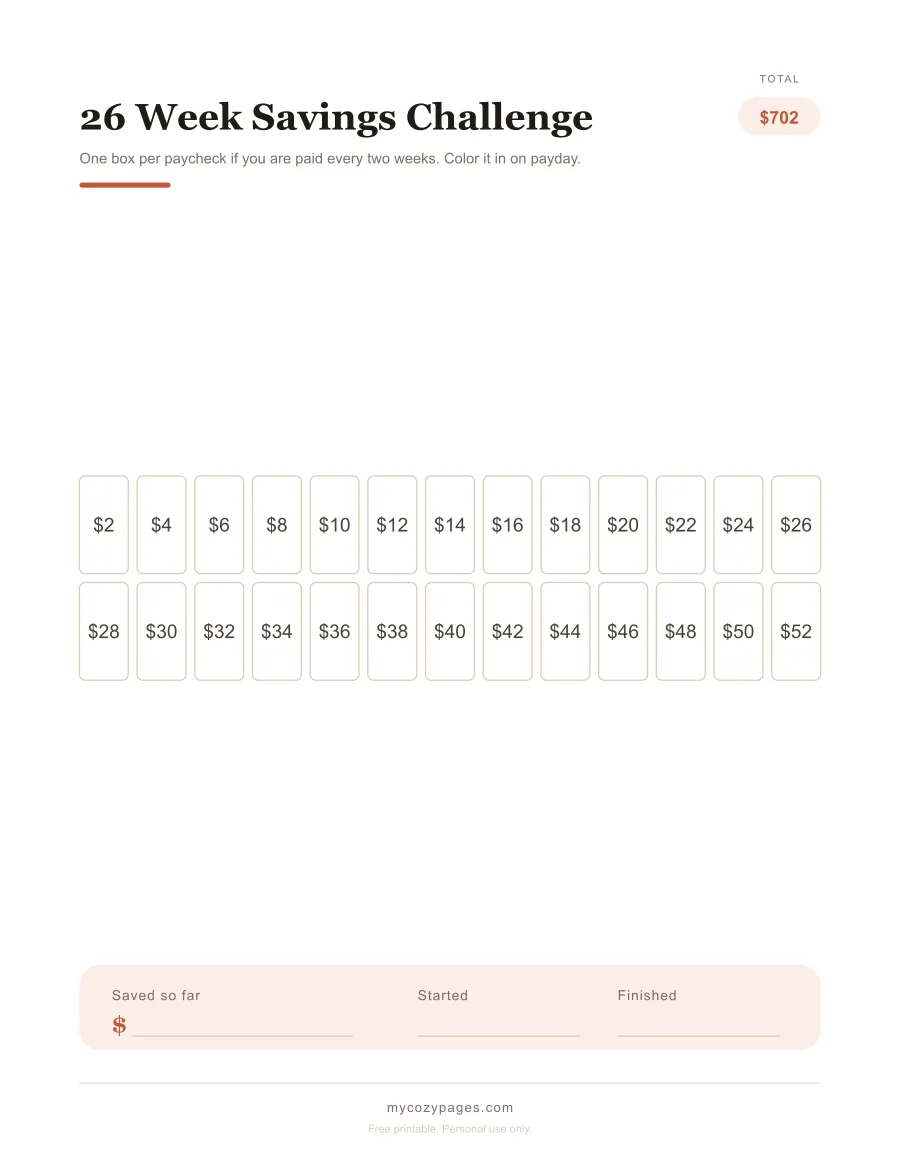
Built around payday rather than the calendar week. Twenty-six deposits that start at $2 and climb to $52.
- Total saved
- $702
- Boxes to fill
- 26
- How long it takes
- 1 year, 26 deposits
- Best for
- Getting paid every two weeks
$1,000 Savings Challenge
One hundred boxes worth $10 each. There is no weekly schedule, so you fill them in whenever you have the money.
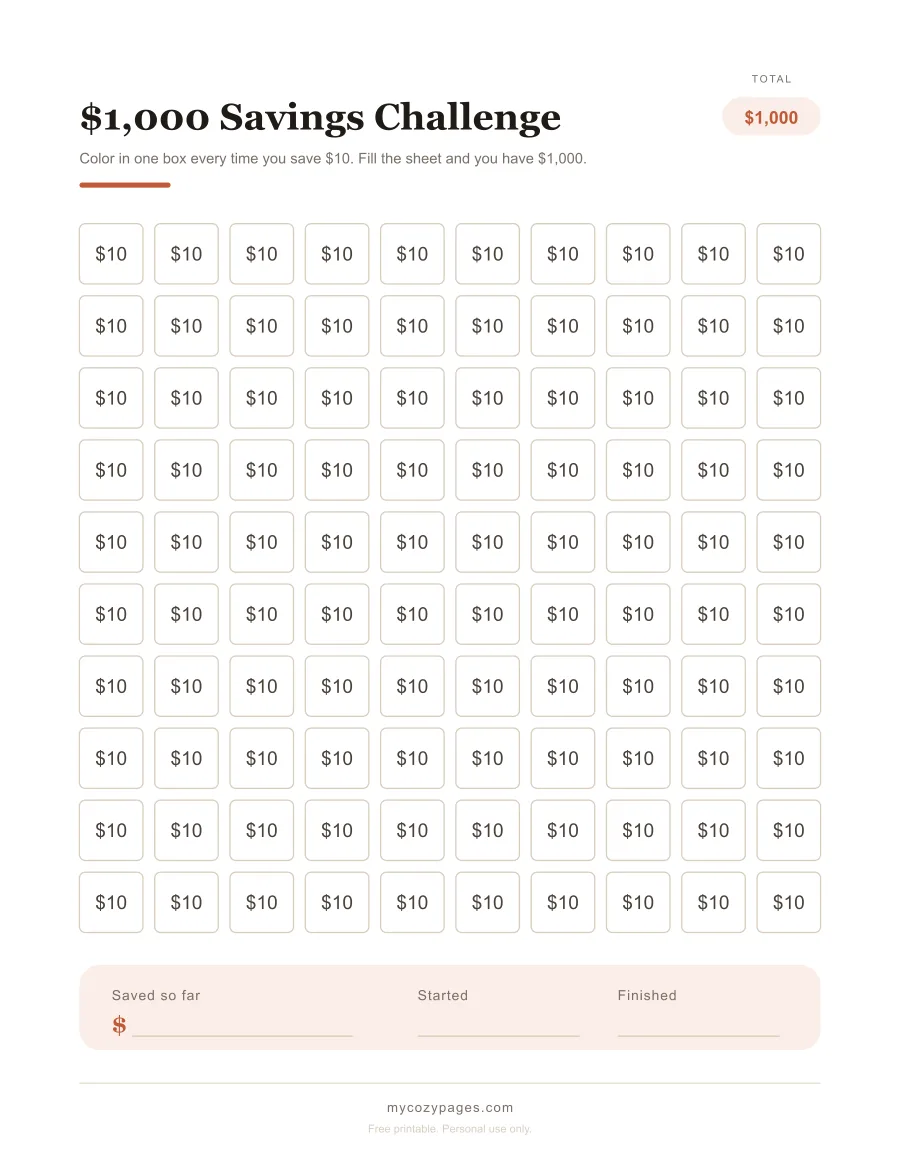
- Total saved
- $1,000
- Boxes to fill
- 100
- How long it takes
- However long you need
- Best for
- A first emergency fund
$5,000 Savings Challenge
The same idea as the $1,000 sheet, scaled up. One hundred boxes, $50 in each.
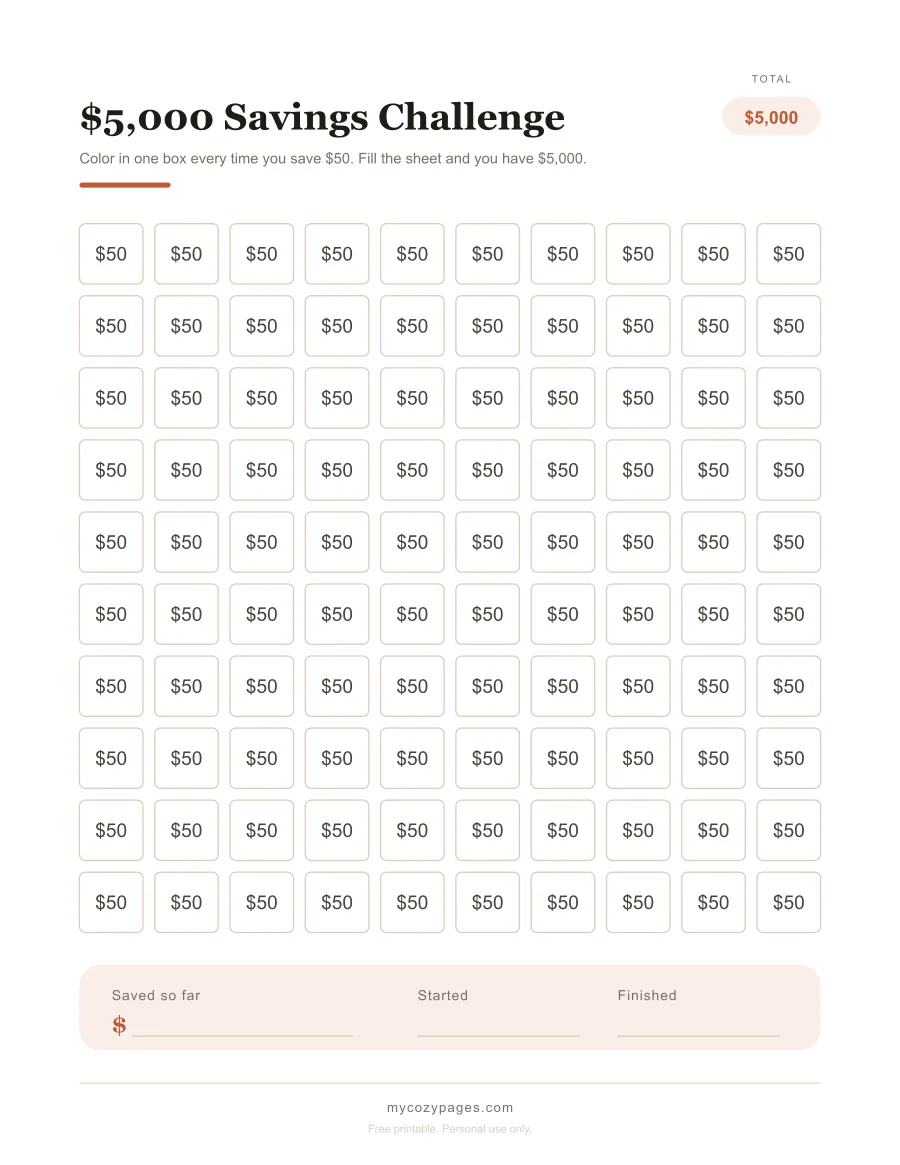
- Total saved
- $5,000
- Boxes to fill
- 100
- How long it takes
- However long you need
- Best for
- A bigger goal with no deadline
$10,000 Savings Challenge
A long game. One hundred boxes at $100 each, usually spread over a year or two rather than a few months.
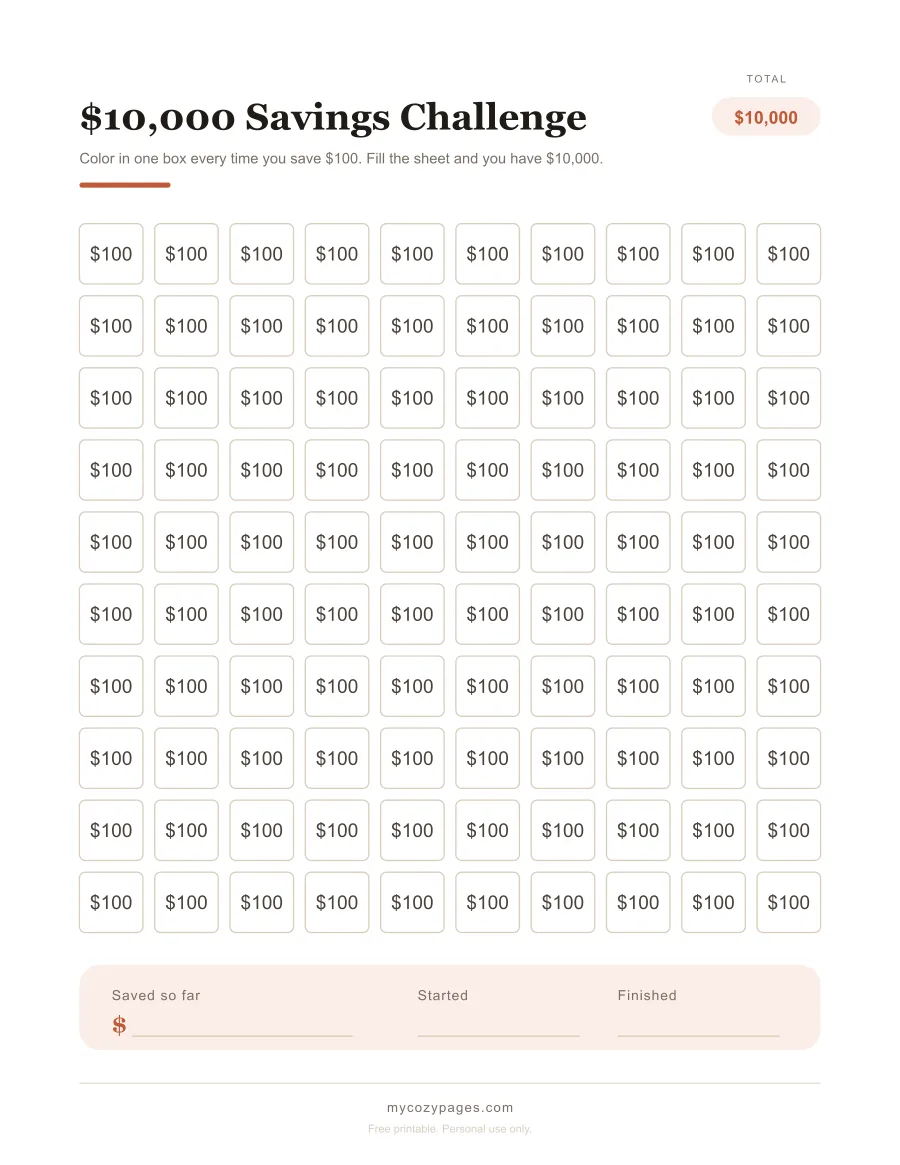
- Total saved
- $10,000
- Boxes to fill
- 100
- How long it takes
- However long you need
- Best for
- A down payment or a car fund
100 Envelope Challenge
Number one hundred envelopes, then pick one at random each day and put that many dollars inside. This sheet works as the tracker.
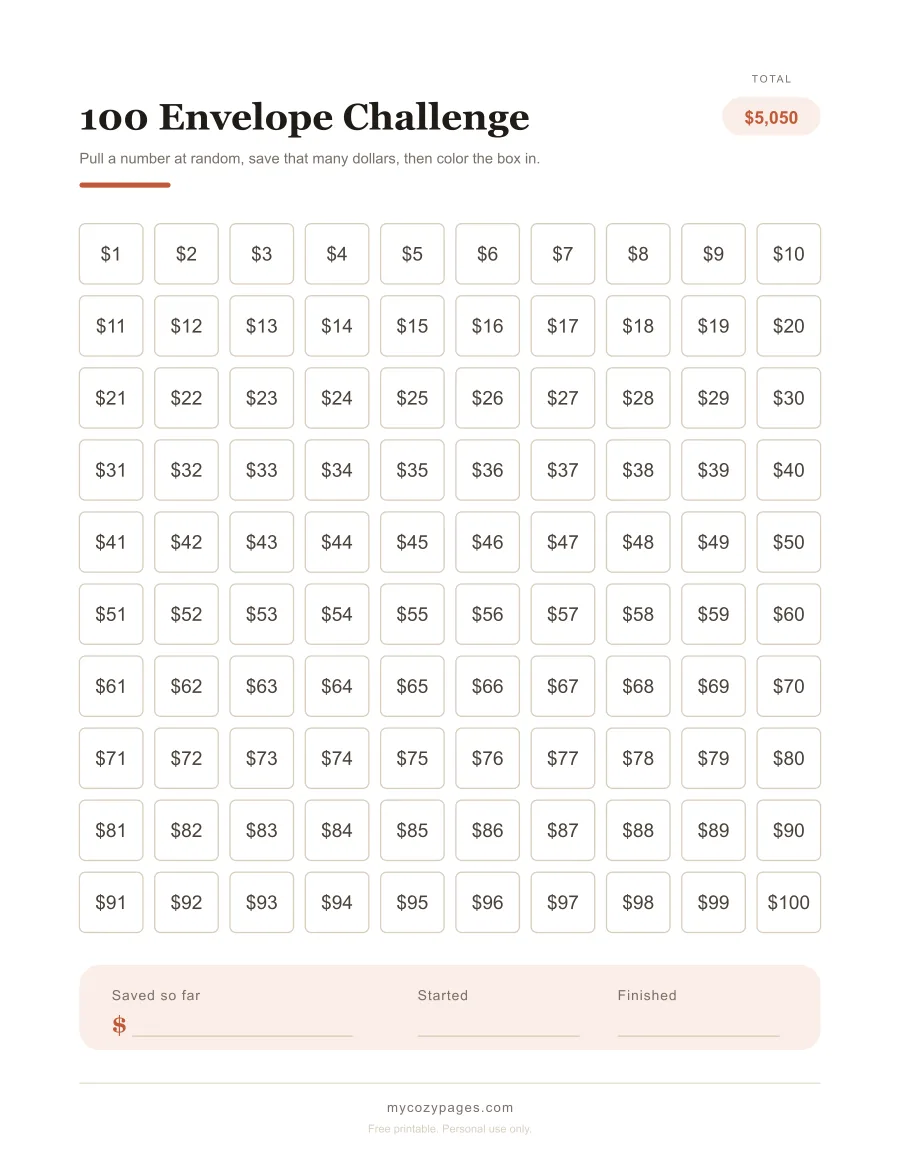
- Total saved
- $5,050
- Boxes to fill
- 100
- How long it takes
- Around 3 months at 1 a day
- Best for
- People who want it to feel like a game
Penny Challenge (365 days)
The gentlest start there is. Day one costs you a penny. The amounts stay small for months and only reach $3.65 on the very last day.
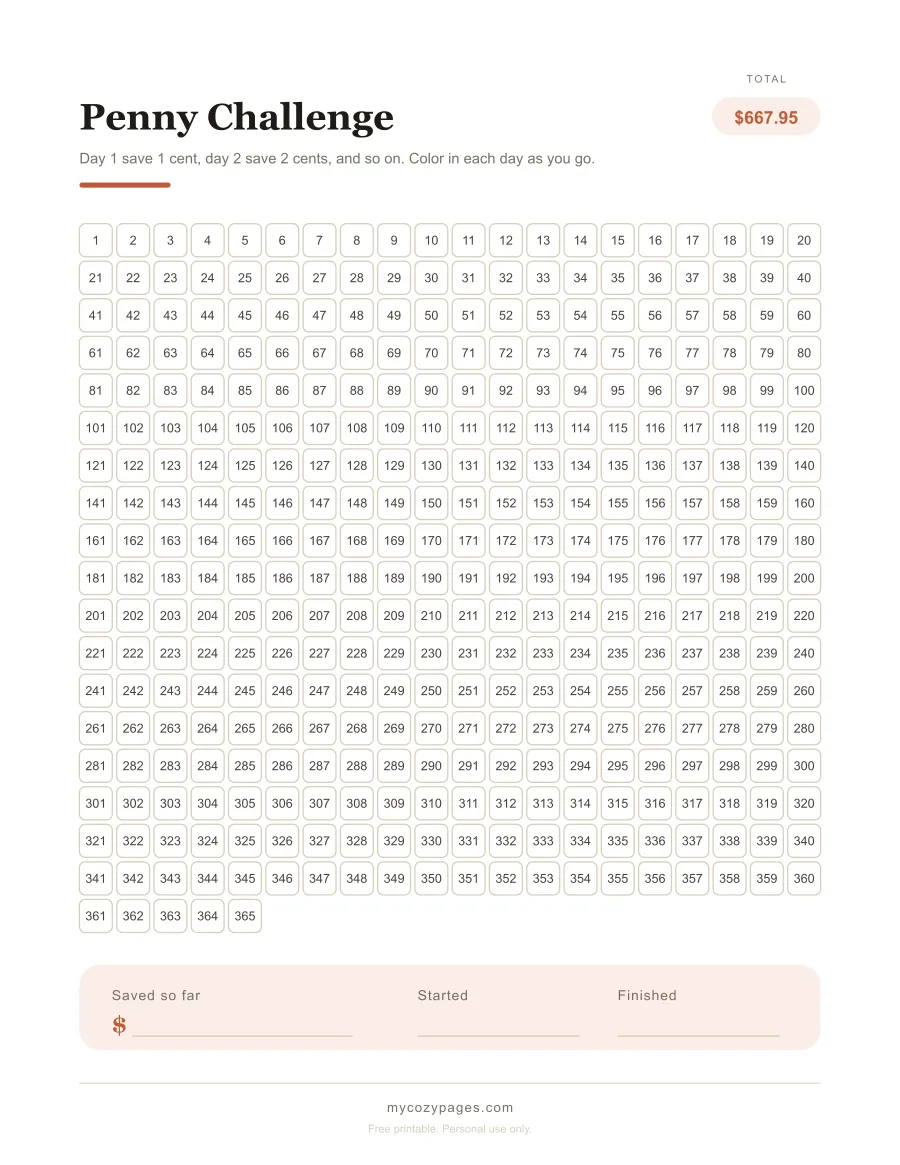
- Total saved
- $667.95
- Boxes to fill
- 365
- How long it takes
- 1 year
- Best for
- Starting with almost nothing
Monthly Savings Challenge
Twelve deposits instead of fifty-two. It starts at $25 in month one and rises by $25 each month to $300.
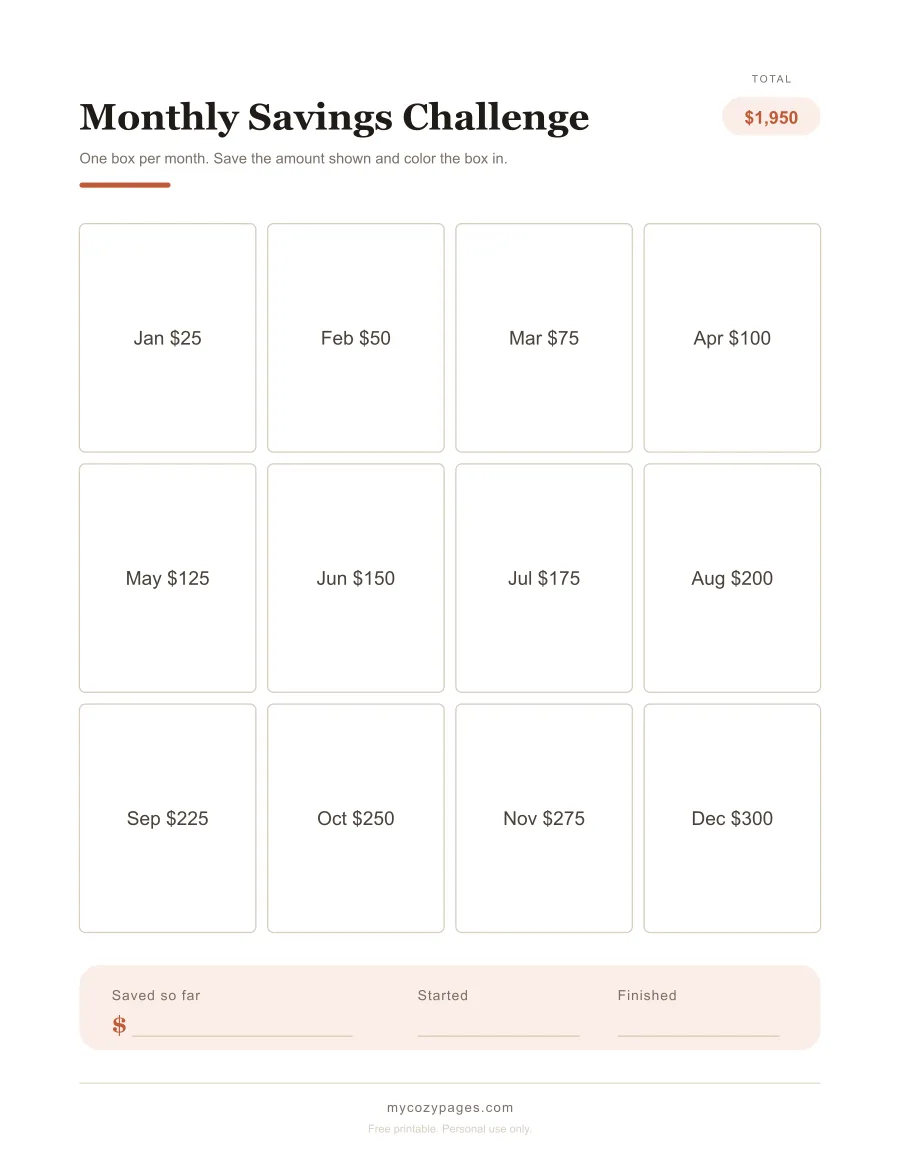
- Total saved
- $1,950
- Boxes to fill
- 12
- How long it takes
- 1 year, 12 deposits
- Best for
- Saving once a month, not weekly
Mini $500 Savings Challenge
The smallest amounts on this page. One hundred boxes at $5 each, with no deadline attached.
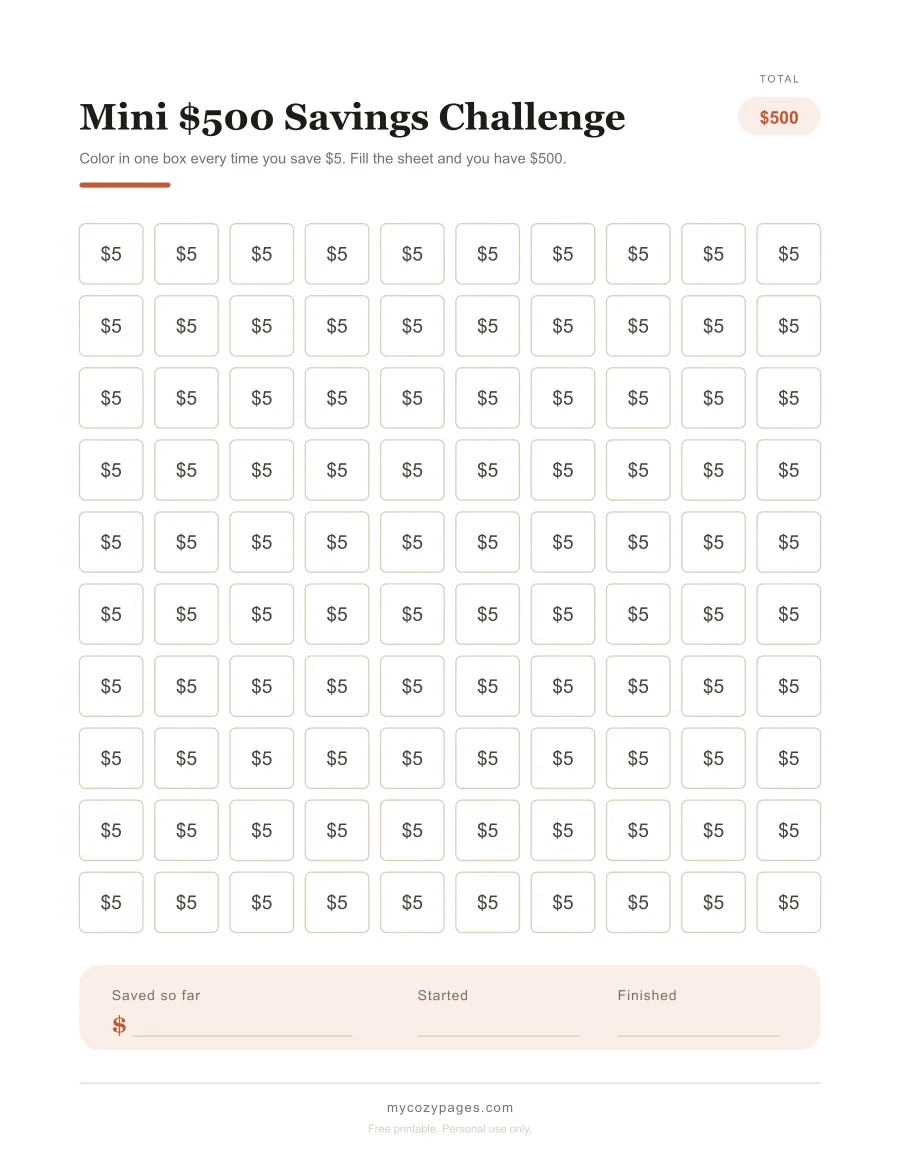
- Total saved
- $500
- Boxes to fill
- 100
- How long it takes
- However long you need
- Best for
- A tight budget or a first try
Flexible Savings Challenge
For anyone who has started a fixed challenge and stopped. The amounts are mixed up and there is no order to follow, so a tight week costs you a $5 box instead of your whole streak.
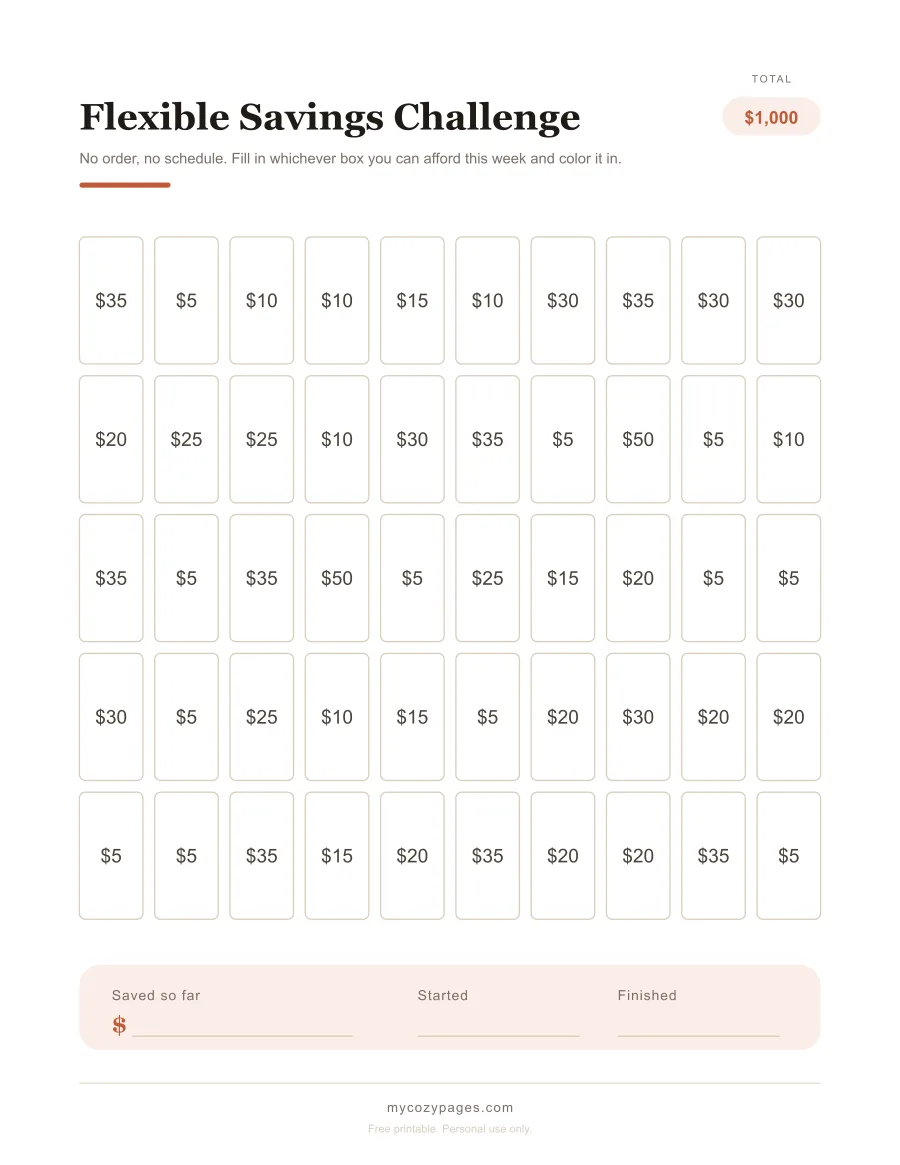
- Total saved
- $1,000
- Boxes to fill
- 50
- How long it takes
- However long you need
- Best for
- Anyone who has quit a fixed challenge before
Compare all 11
| Challenge | Total saved | Boxes | How long | Best for |
|---|---|---|---|---|
| 52 Week Savings Challenge | $1,378 | 52 | 1 year | A steady weekly habit |
| Reverse 52 Week Savings Challenge | $1,378 | 52 | 1 year | Saving more early in the year |
| 26 Week (Bi-Weekly) Savings Challenge | $702 | 26 | 1 year, 26 deposits | Getting paid every two weeks |
| $1,000 Savings Challenge | $1,000 | 100 | However long you need | A first emergency fund |
| $5,000 Savings Challenge | $5,000 | 100 | However long you need | A bigger goal with no deadline |
| $10,000 Savings Challenge | $10,000 | 100 | However long you need | A down payment or a car fund |
| 100 Envelope Challenge | $5,050 | 100 | Around 3 months at 1 a day | People who want it to feel like a game |
| Penny Challenge (365 days) | $667.95 | 365 | 1 year | Starting with almost nothing |
| Monthly Savings Challenge | $1,950 | 12 | 1 year, 12 deposits | Saving once a month, not weekly |
| Mini $500 Savings Challenge | $500 | 100 | However long you need | A tight budget or a first try |
| Flexible Savings Challenge | $1,000 | 50 | However long you need | Anyone who has quit a fixed challenge before |
Pick by goal
A first emergency fund. Start with Mini $500, then move to $1,000. Having a few hundred dollars set aside covers most small emergencies, and it is a much easier target to hit than three months of expenses.
Christmas or the holidays. The Monthly sheet suits this, because you can start in January and be finished by December with $1,950. If you start later, use $1,000 and fill boxes faster.
A car, or repairs on the one you have. $5,000 covers a decent used car or a serious repair bill. There is no deadline on the sheet, so it bends around the months when nothing is left over.
A vacation. 52 Week lands at $1,378 after a year, which is a realistic trip for one or two people. Start it in January and the money is there for the following summer.
A down payment. $10,000 is the sheet for this. Most people take a year or two over it rather than twelve months, and that is fine.
No particular goal, you just want to start. Flexible. Fill in whichever box you can afford, in any order.
Pick by situation
You are on a low income. Penny Challenge asks for one cent on day one and stays under a dollar a day for most of the year. Mini $500 is the other one to look at, because a $5 box is achievable in almost any week.
You are paid every two weeks. 26 Week has one box per paycheck rather than one per calendar week, so saving happens on payday.
Your income is irregular. Avoid anything with a weekly schedule. Flexible, $1,000 and Mini $500 have no dates on them at all, so a quiet month costs you nothing but time.
You are saving as a couple. Print two copies of the same sheet and keep them side by side, or share one and take turns filling boxes. $5,000 works well split two ways.
You have children at home. Mini $500 and Penny Challenge have the smallest amounts, and coloring in the boxes is the part children actually want to do.
You have quit a challenge before. Flexible exists for this. There is no order to follow, so a bad week costs you a $5 box instead of your streak.
Starting a savings challenge in January 2027
Five of these sheets are built around a calendar year, so a January 1 start lines up neatly:
- 52 Week and Reverse 52 Week run week 1 to week 52, finishing at the end of December.
- 26 Week runs across 26 paychecks, which is roughly a year for most two-week pay schedules.
- Monthly has one box per month, January through December.
- Penny Challenge runs 365 days, so it finishes on New Year’s Eve.
Starting later in the year is not a problem. The other six sheets have no dates on them at all. $1,000, $5,000, $10,000, Mini $500, 100 Envelope and Flexible all start the day you print them.
If you want a weekly sheet in, say, June, you have two options: start the 52 week challenge anyway and finish it next June, or work through it out of order and fill the small boxes during the tight months. The sheet does not know what month it is.
What if you fall behind?
Almost everyone does at some point. Falling behind is not a reason to stop, and it does not mean starting over.
- Fill the boxes out of order. Nothing says you have to go left to right. In a tight week, color a $5 box and leave the $40 one for later. The total at the end is the same.
- Halve everything and finish anyway. Half of the 52 week challenge is $689. That is a real result, and it beats an abandoned sheet.
- Catch up on one good month. If a tax refund or a bonus turns up, color in several boxes at once. There is no rule against it.
- Switch sheets. If the challenge you picked is genuinely too big, move to Flexible or Mini $500 and carry over what you have already saved. Changing the plan is not quitting.
Tips to stick with it
Make the amount boring. A challenge you can manage in a bad month is worth more than one that only works in a good month. There is no prize for the hardest sheet.
Automate the part you can. If your bank lets you schedule a transfer, set it for the same day each week and color the box when it goes through. The sheet then records what already happened.
Put the reason at the top. Write what you are saving for above the grid. It is easier to skip a takeout order for “car repair fund” than for “savings.”
Keep the money slightly annoying to reach. A separate account without a card, or an envelope at the back of a drawer. Not impossible, just far enough away that spending it takes a decision.
Print the next sheet before you finish the last one. Starting the next while the old one is still on the refrigerator is the easiest way to keep going.
A note before you start
These printables are organizing tools, not financial advice. They do not know your income, your bills or your situation, and filling one in does not guarantee any particular result. If you are weighing saving against paying off a debt, or you want advice about your own money, please talk to a qualified professional.
Print the sheet, save what you can, color the box.
Want something else to print? Browse all the free printables, or read a little more about who makes them.
Save it for later
Eleven free printable savings challenges in one PDF, from a $500 mini sheet up to $10,000. Color in a box each time you save and watch the year fill up. Weekly, biweekly, monthly and no-set-amount versions, all US Letter and light on ink. Free download, no email needed.
Save this pinFrequently asked questions
Do savings challenges really work?
They work for some people because they make saving visible and specific. A tracker will not create money you do not have, but it turns a vague plan into a set of small steps and makes a skipped week obvious. Whether you finish depends on picking an amount you can actually manage.
How much does the 52 week savings challenge save?
Exactly $1,378. You save $1 in week one, $2 in week two, and so on up to $52 in the final week. Added together, the 52 weekly amounts come to $1,378.
What is the most popular savings challenge?
The 52 week challenge is the best known, and the 100 envelope challenge is the one people share most. The 52 week sheet suits a steady weekly habit, while the envelope version turns saving into a daily draw and reaches $5,050.
Can I start a savings challenge in the middle of the year?
Yes. Six of these eleven sheets have no dates on them at all, so they start whenever you print them. The $1,000, $5,000, $10,000, Mini $500, 100 envelope and Flexible sheets all work from any date.
Where should I keep the money?
Anywhere that is not your everyday checking account. A separate savings account without a debit card works well, and so does a cash envelope or a jar if you prefer paper money. The point is that reaching it takes one extra step.
Can I do a savings challenge on a low income?
Yes, as long as you pick a sheet with small amounts. The penny challenge starts at one cent a day, and the Mini $500 sheet uses $5 boxes with no deadline. Finishing a small challenge is worth more than abandoning a big one.
What if I get paid every two weeks?
Use the 26 week sheet. It has one box per paycheck instead of one per calendar week, so you save on payday rather than trying to remember mid-week. It runs from $2 up to $52 and totals $702.
Can kids do a savings challenge?
They can, and the Mini $500 sheet or the penny challenge suit them best because the amounts stay small. Coloring in a box is the part children tend to enjoy, so it works well for showing how saving adds up.
Get the free starter kit
An optional bundle sent by email: a budget sheet, a bill tracker and a savings challenge to get you started. Every printable on the site stays free to download without it.
Unsubscribe any time. No spam, ever.