Savings Challenges
52 Week Savings Challenge Printable: 16 Free Charts
Save $1,378 in 2027 with 16 free 52 week charts: dated 2027, reverse, biweekly, kids, fillable and more. Every total checked. No email needed.
The 52 week savings challenge means saving $1 in week one, $2 in week two, and so on up to $52 in the final week. It adds up to exactly $1,378 in a year. The 52 week money challenge is the same thing under a different name. Below are sixteen free printable charts, including a dated 2027 version.
Quick picks
- The standard one: Classic
- Worried about December: Reverse
- Starting January 1, 2027: 2027 dated chart
- Starting any other week: Blank dates
- Paid every two weeks: Biweekly
- Saving with children: Kids version
Every chart is a free PDF with no email and no account. The full week-by-week table is on this page too, so you can check the numbers before you print anything.
How the 52 week savings challenge works
One deposit a week, growing by a dollar each time. Week one costs you $1. Week two costs $2. By the last week of the year you are putting away $52, and the 52 deposits together come to $1,378.
That is the whole rule. What makes it work for people is that it starts almost free, so there is no reason not to begin, and the amount only creeps up as the habit settles in.
It is worth knowing the shape of it before you start:
- The first 26 weeks only add up to $351.
- The last 26 weeks add up to $1,027, almost three times as much.
- Weeks 40 to 52, which is October through December, come to $598. That is 43 percent of the whole year in the last three months.
Nobody tells you that part, and it is the reason most people stop in November. There are four straightforward ways around it, and they are further down the page.
Week by week, with running totals
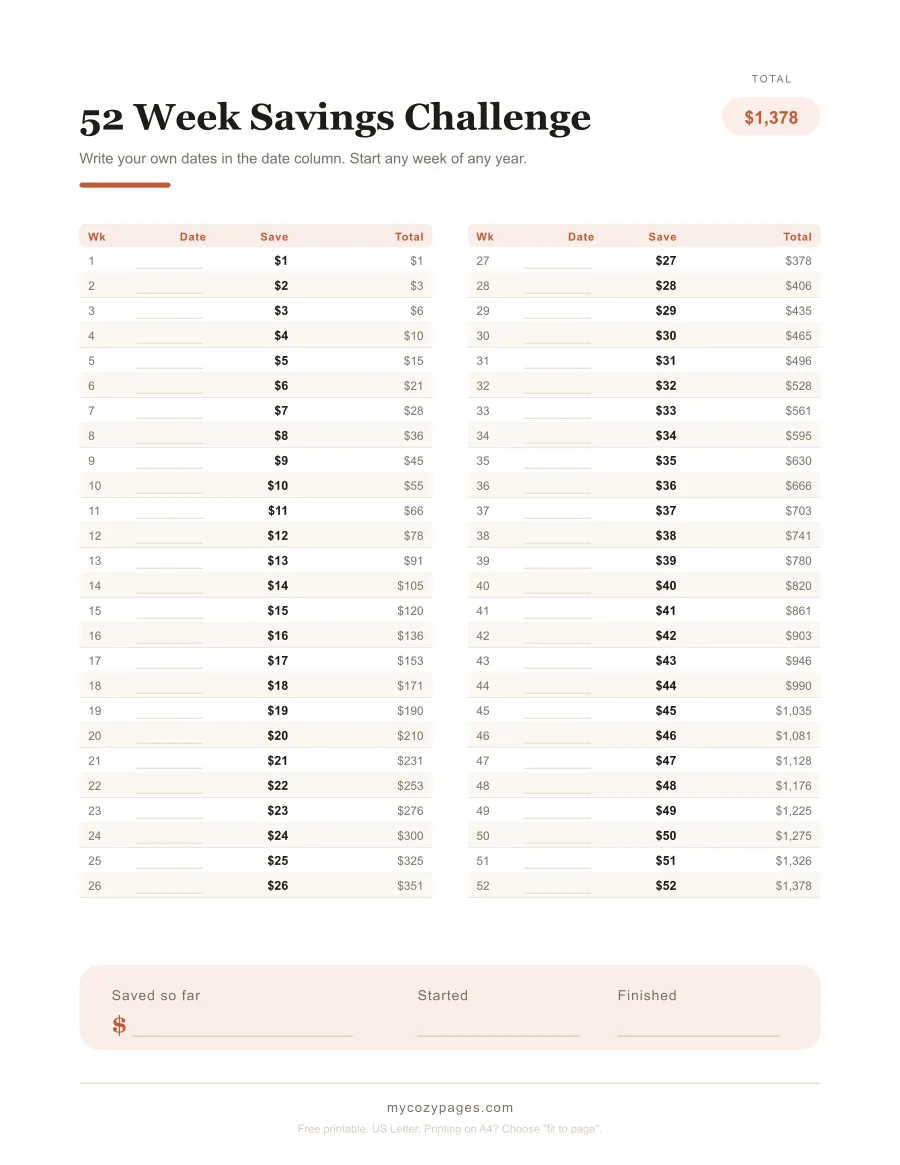
Here is every week of the classic challenge. The dates below are set for a Friday January 1, 2027 start. Change the start date and only the date column updates.
Pick any date. The table updates in place, and you can still read everything without it.
| Week | Date | Save | Total |
|---|---|---|---|
| 1 | Jan 1 | $1 | $1 |
| 2 | Jan 8 | $2 | $3 |
| 3 | Jan 15 | $3 | $6 |
| 4 | Jan 22 | $4 | $10 |
| 5 | Jan 29 | $5 | $15 |
| 6 | Feb 5 | $6 | $21 |
| 7 | Feb 12 | $7 | $28 |
| 8 | Feb 19 | $8 | $36 |
| 9 | Feb 26 | $9 | $45 |
| 10 | Mar 5 | $10 | $55 |
| 11 | Mar 12 | $11 | $66 |
| 12 | Mar 19 | $12 | $78 |
| 13 | Mar 26 | $13 | $91 |
| 14 | Apr 2 | $14 | $105 |
| 15 | Apr 9 | $15 | $120 |
| 16 | Apr 16 | $16 | $136 |
| 17 | Apr 23 | $17 | $153 |
| 18 | Apr 30 | $18 | $171 |
| 19 | May 7 | $19 | $190 |
| 20 | May 14 | $20 | $210 |
| 21 | May 21 | $21 | $231 |
| 22 | May 28 | $22 | $253 |
| 23 | Jun 4 | $23 | $276 |
| 24 | Jun 11 | $24 | $300 |
| 25 | Jun 18 | $25 | $325 |
| 26 | Jun 25 | $26 | $351 |
| 27 | Jul 2 | $27 | $378 |
| 28 | Jul 9 | $28 | $406 |
| 29 | Jul 16 | $29 | $435 |
| 30 | Jul 23 | $30 | $465 |
| 31 | Jul 30 | $31 | $496 |
| 32 | Aug 6 | $32 | $528 |
| 33 | Aug 13 | $33 | $561 |
| 34 | Aug 20 | $34 | $595 |
| 35 | Aug 27 | $35 | $630 |
| 36 | Sep 3 | $36 | $666 |
| 37 | Sep 10 | $37 | $703 |
| 38 | Sep 17 | $38 | $741 |
| 39 | Sep 24 | $39 | $780 |
| 40 | Oct 1 | $40 | $820 |
| 41 | Oct 8 | $41 | $861 |
| 42 | Oct 15 | $42 | $903 |
| 43 | Oct 22 | $43 | $946 |
| 44 | Oct 29 | $44 | $990 |
| 45 | Nov 5 | $45 | $1,035 |
| 46 | Nov 12 | $46 | $1,081 |
| 47 | Nov 19 | $47 | $1,128 |
| 48 | Nov 26 | $48 | $1,176 |
| 49 | Dec 3 | $49 | $1,225 |
| 50 | Dec 10 | $50 | $1,275 |
| 51 | Dec 17 | $51 | $1,326 |
| 52 | Dec 24 | $52 | $1,378 |
The 16 free printable charts
Sixteen versions of the same challenge. Tap any preview to see the full sheet before you download it.
Classic 52 Week Challenge
Week one you put away $1, week two $2, and so on to $52 in the final week. It adds up to $1,378 without ever asking for a big deposit early on.
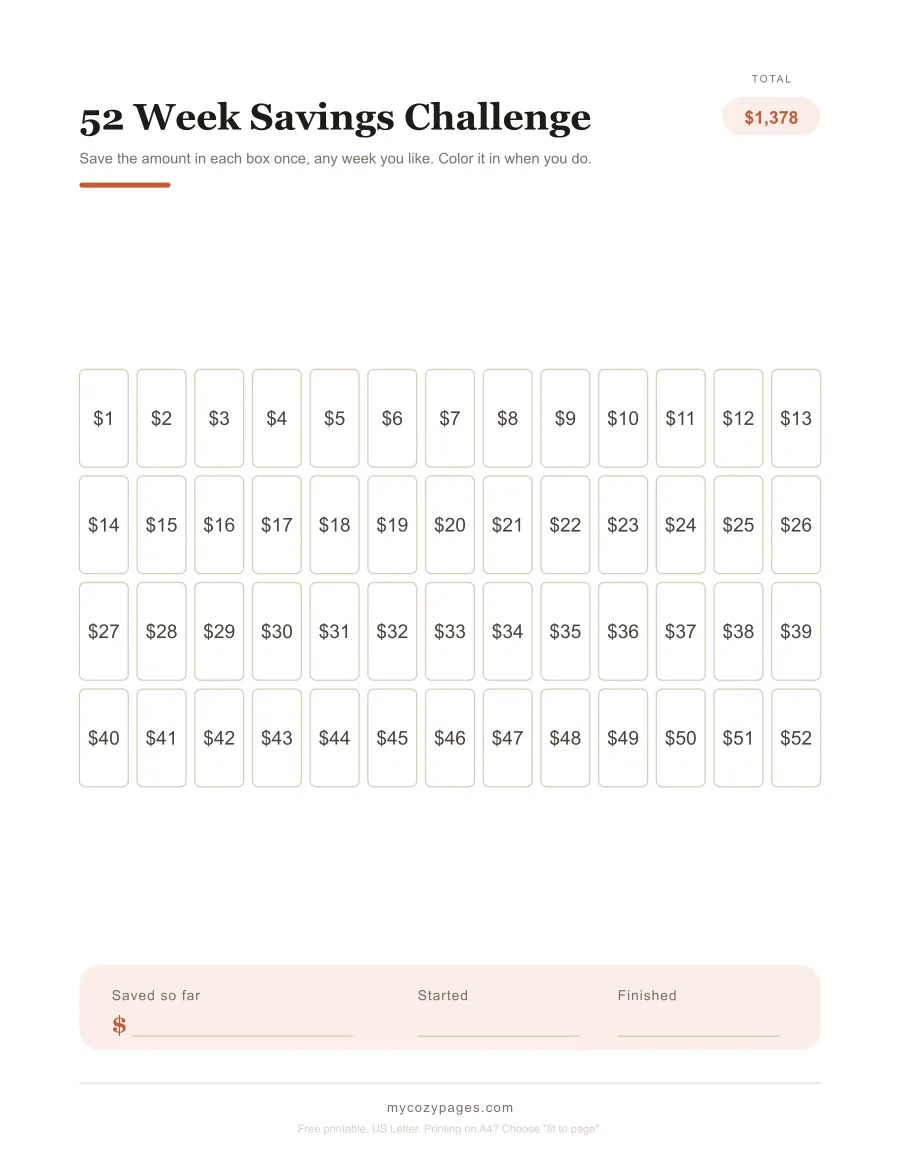
- Total saved
- $1,378
- Deposits
- 52
- Biggest week
- $52
- Best for
- The standard version, and the one most people mean
Reverse 52 Week Challenge
The same $1,378, flipped. You save $52 in week one and finish with $1, so December asks for pocket change instead of $202.
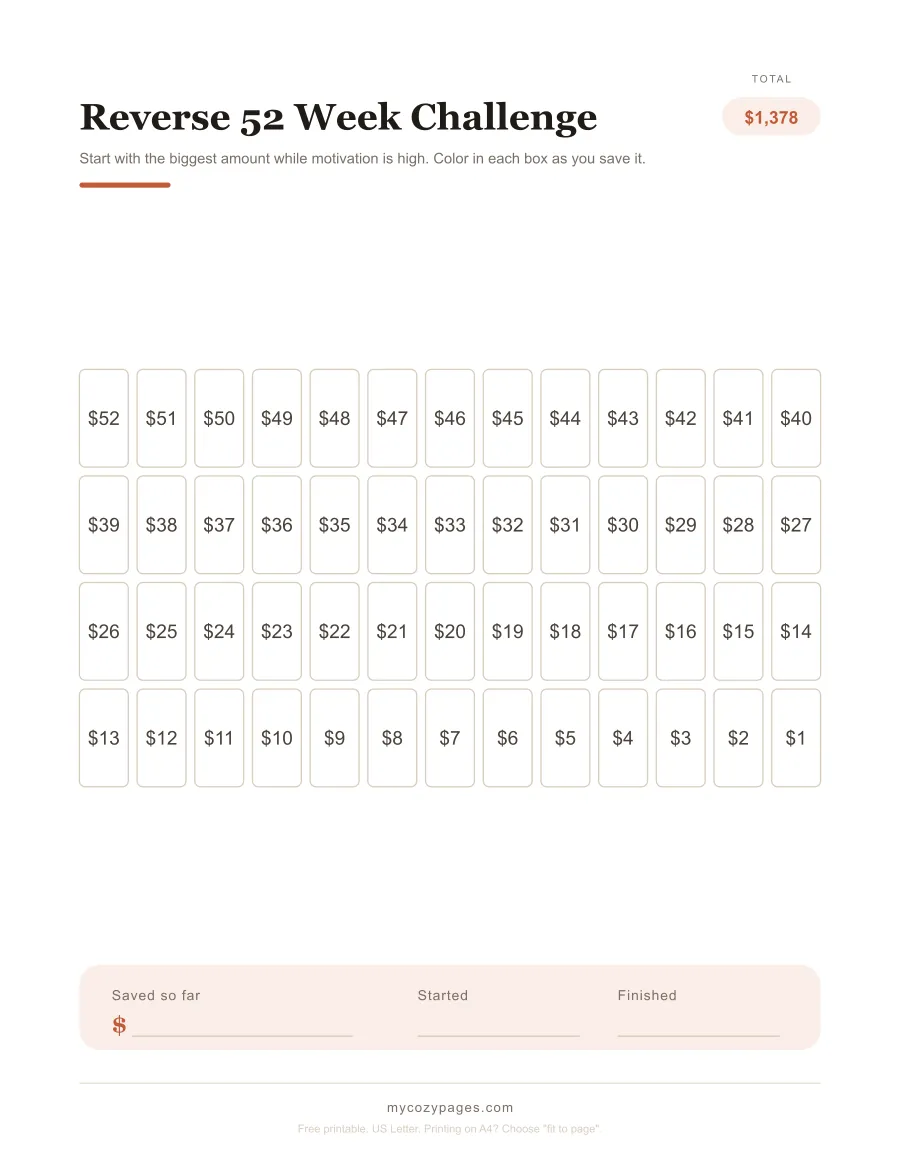
- Total saved
- $1,378
- Deposits
- 52
- Biggest week
- $52
- Best for
- Getting the expensive weeks done before the holidays
2027 Dated Chart
Every row carries the real date. Starting Friday January 1, 2027, the last deposit lands on Friday December 24, which is Christmas Eve.
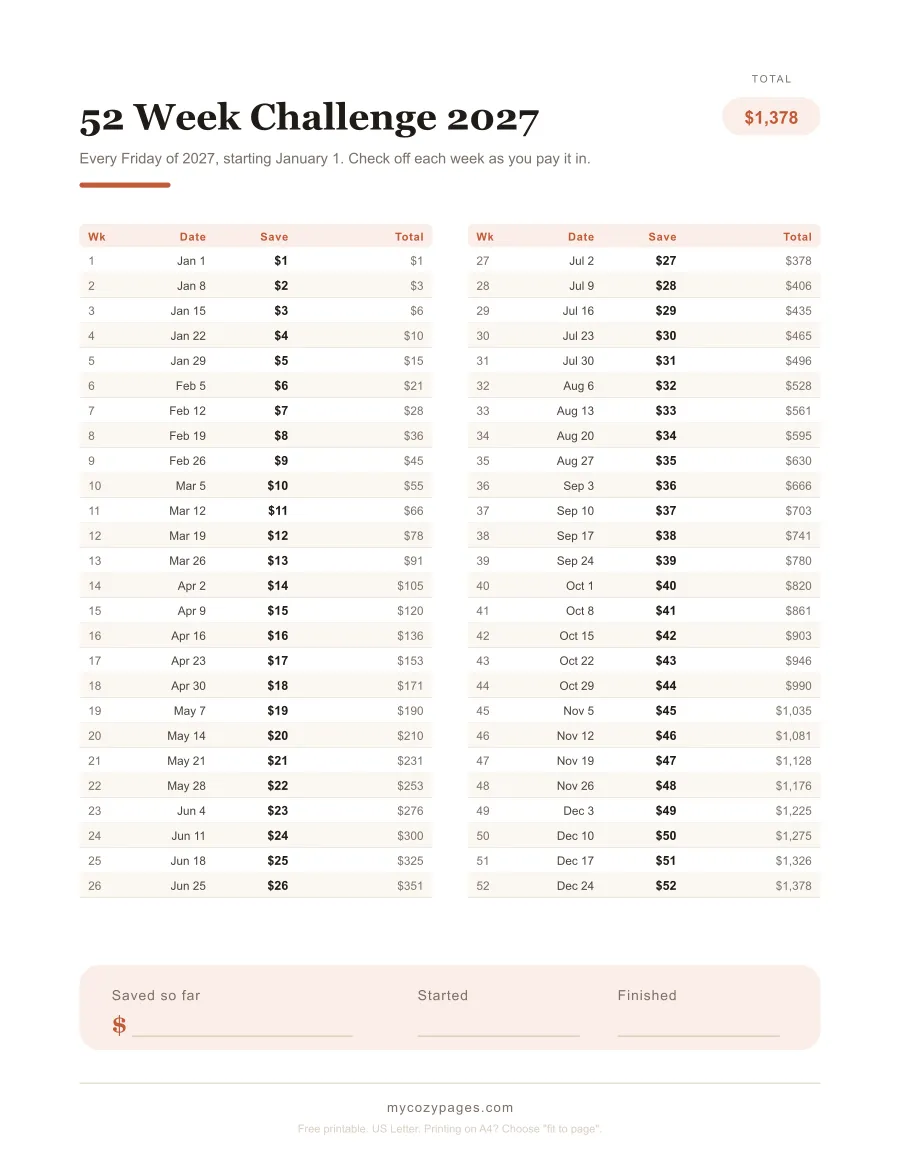
- Total saved
- $1,378
- Deposits
- 52
- Biggest week
- $52
- Best for
- Starting on January 1, 2027 and never wondering which week you are on
Blank Date Chart
The same chart with the date column left empty, so you can start the week you print it instead of waiting for January.
- Total saved
- $1,378
- Deposits
- 52
- Biggest week
- $52
- Best for
- Starting in February, or June, or any week at all
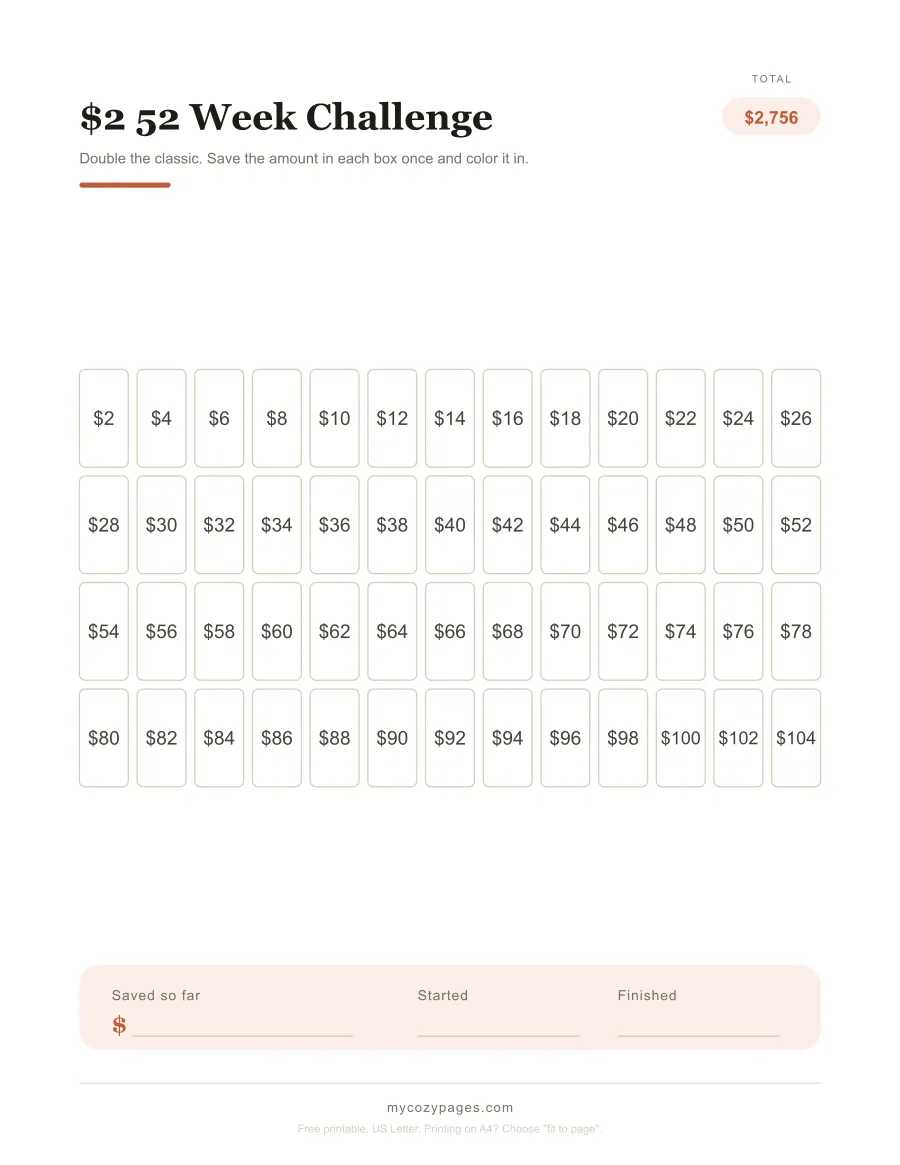
$2 Version
Every amount doubled: $2 in week one up to $104 in week 52, for $2,756. The last month asks for $404, so plan for it.
- Total saved
- $2,756
- Deposits
- 52
- Biggest week
- $104
- Best for
- A bit more than the classic without doubling the hardest week too far
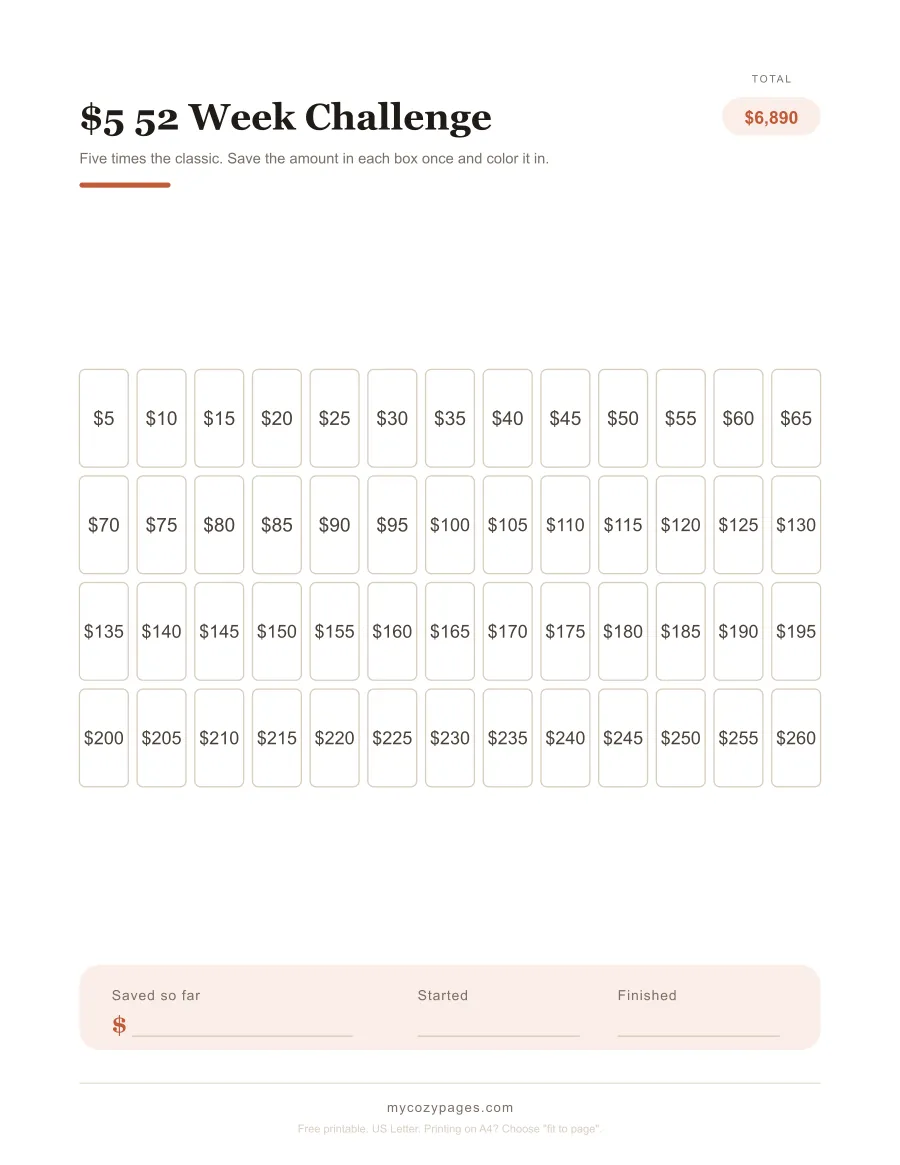
$5 Version
Five times the classic, ending at $260 in the final week for a total of $6,890. Check the last quarter against your real budget before you start this one.
- Total saved
- $6,890
- Deposits
- 52
- Biggest week
- $260
- Best for
- A serious goal with room in the budget
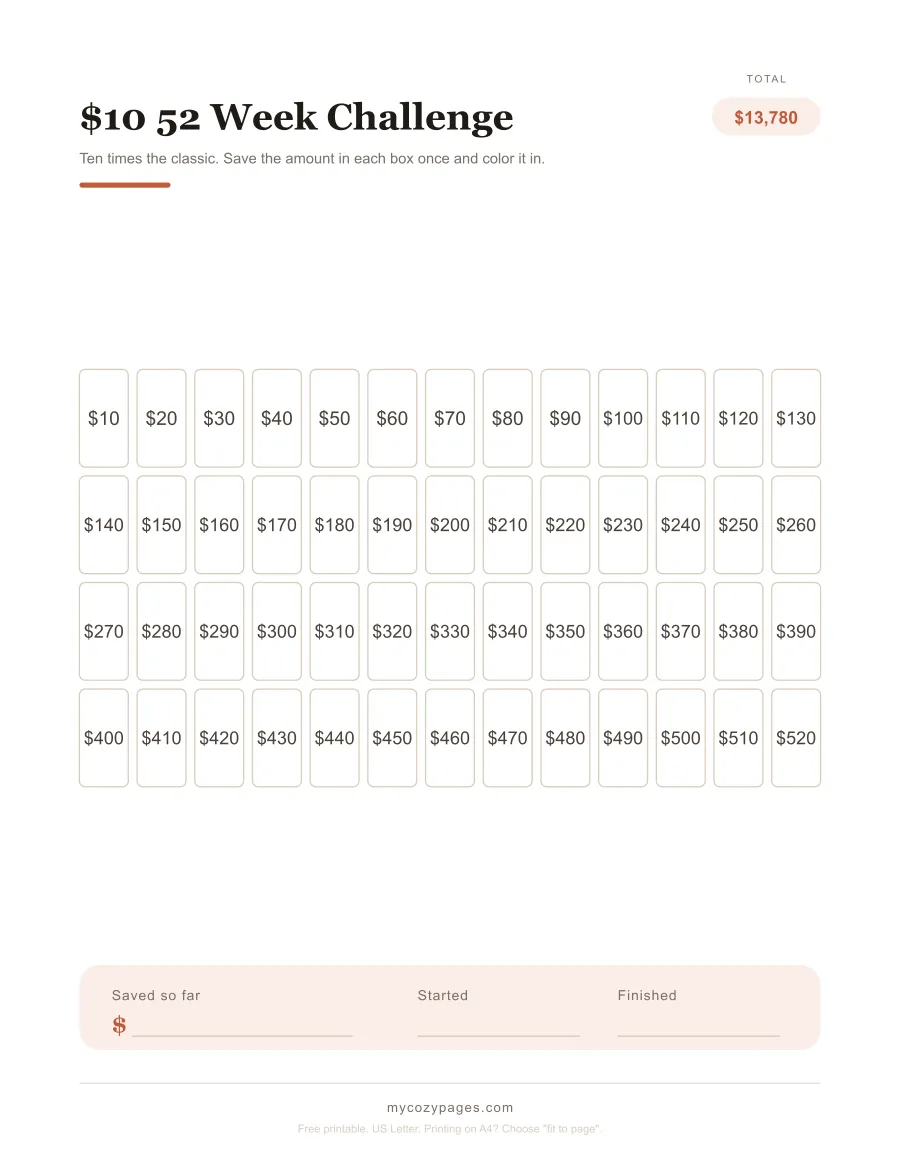
$10 Version
The biggest version here at $13,780. Week 52 alone asks for $520, so this one suits a high or very steady income.
- Total saved
- $13,780
- Deposits
- 52
- Biggest week
- $520
- Best for
- A down payment, if $520 in one week is realistic for you
Biweekly Version
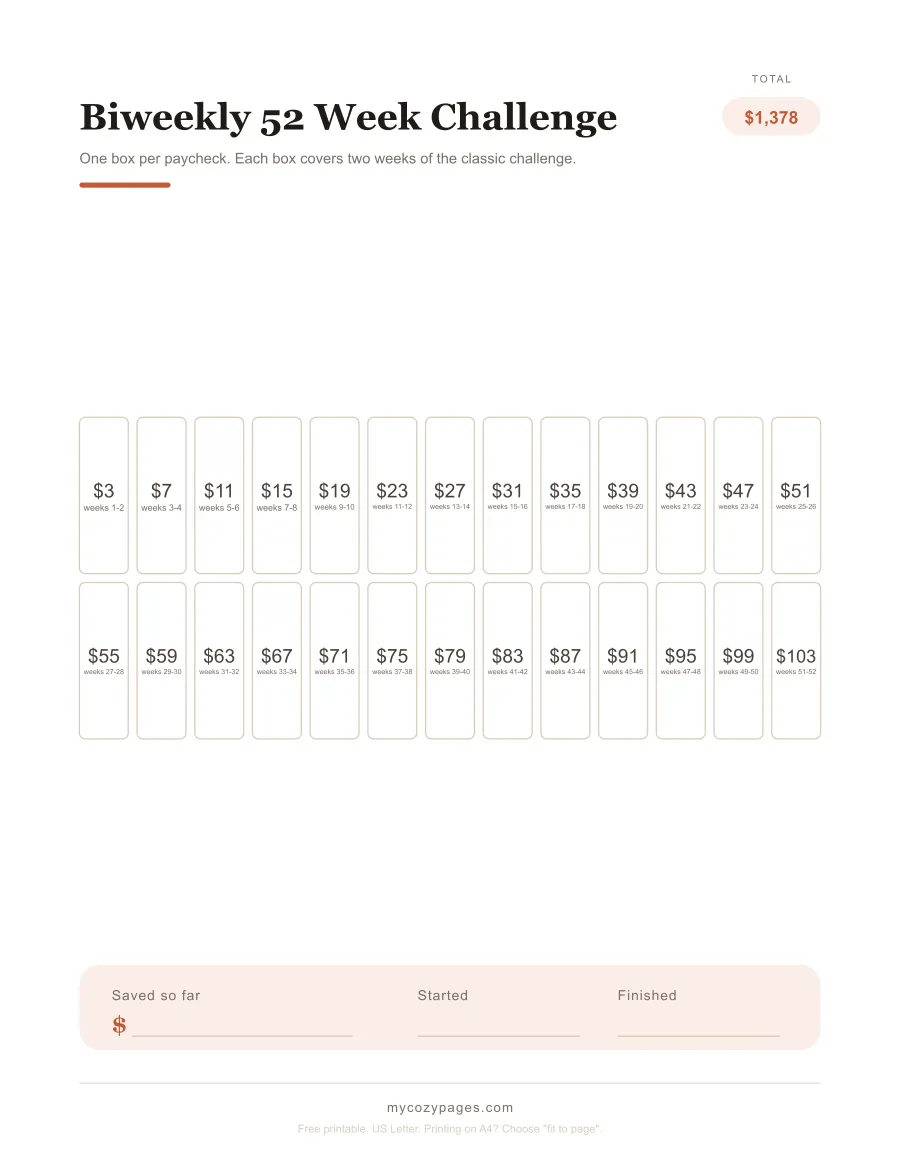
The same $1,378 in 26 deposits instead of 52. Each box adds two weeks of the classic together, running from $3 up to $103, so you pay on payday.
- Total saved
- $1,378
- Deposits
- 26
- Biggest week
- $103
- Best for
- Getting paid every two weeks
Kids Version (quarters)
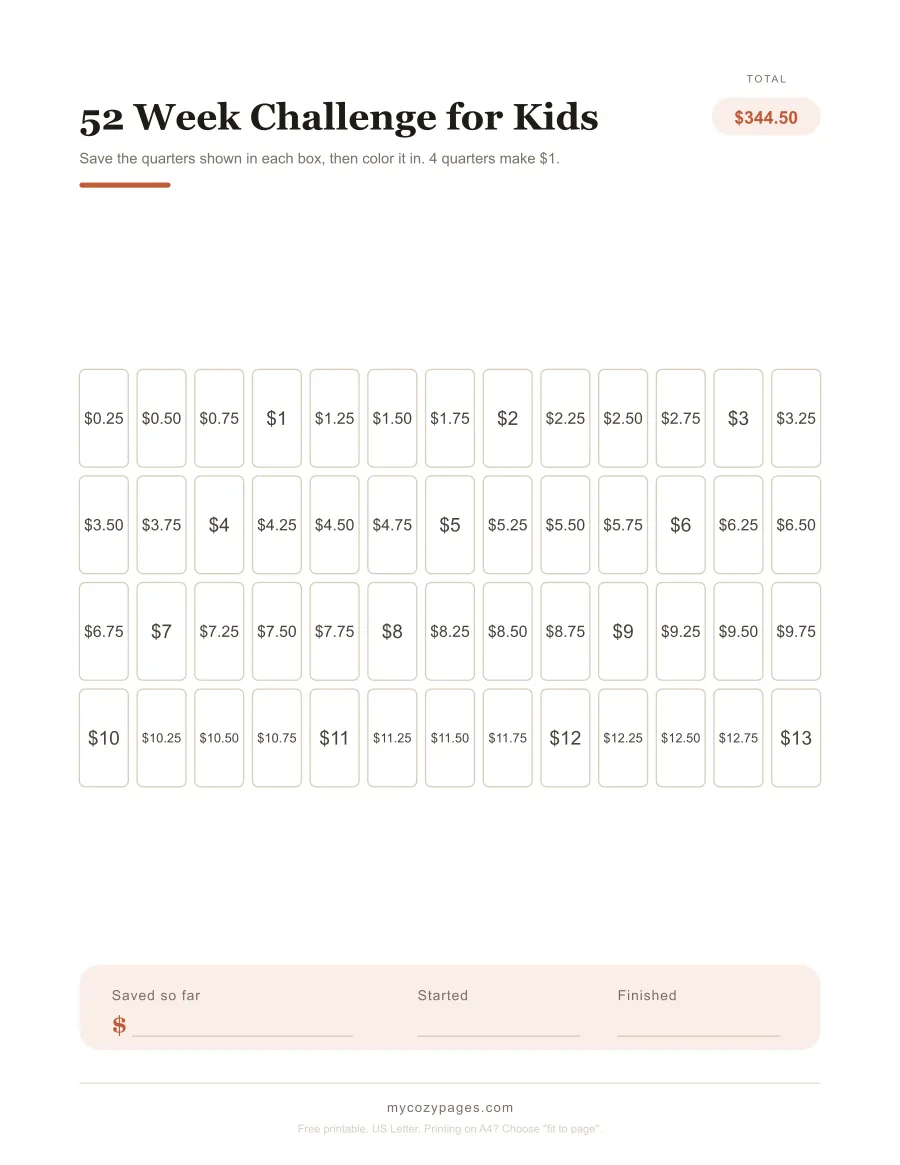
The classic scaled down to quarters. Week one is a single quarter and week 52 is $13, adding up to $344.50 over the year.
- Total saved
- $344.50
- Deposits
- 52
- Biggest week
- $13
- Best for
- Children, pocket money and piggy banks
Cozy Color Chart
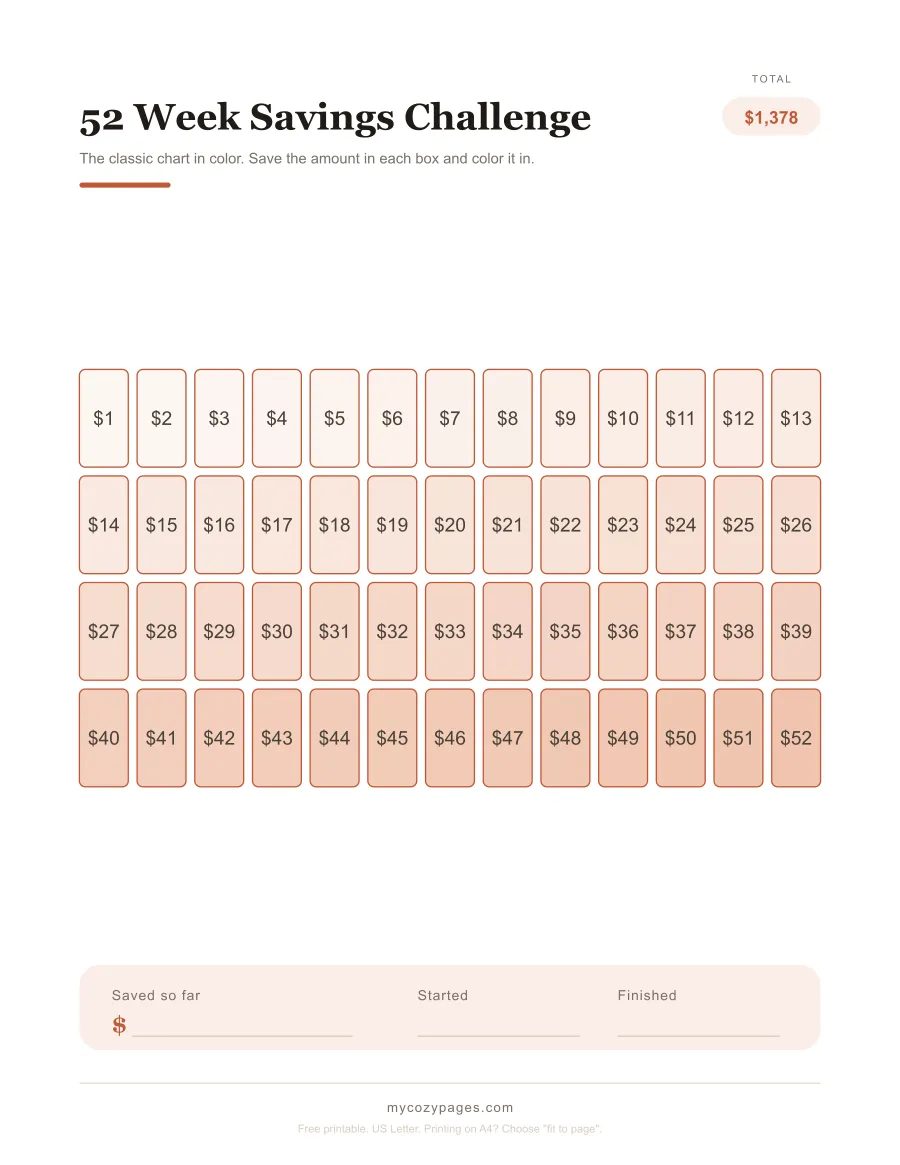
The same $1,378 chart in the site colors, for anyone who would rather look at something warm than a black and white grid. The plain version is still there if you would rather save ink.
- Total saved
- $1,378
- Deposits
- 52
- Biggest week
- $52
- Best for
- A sheet that looks nice on the fridge
Savings Jar Chart
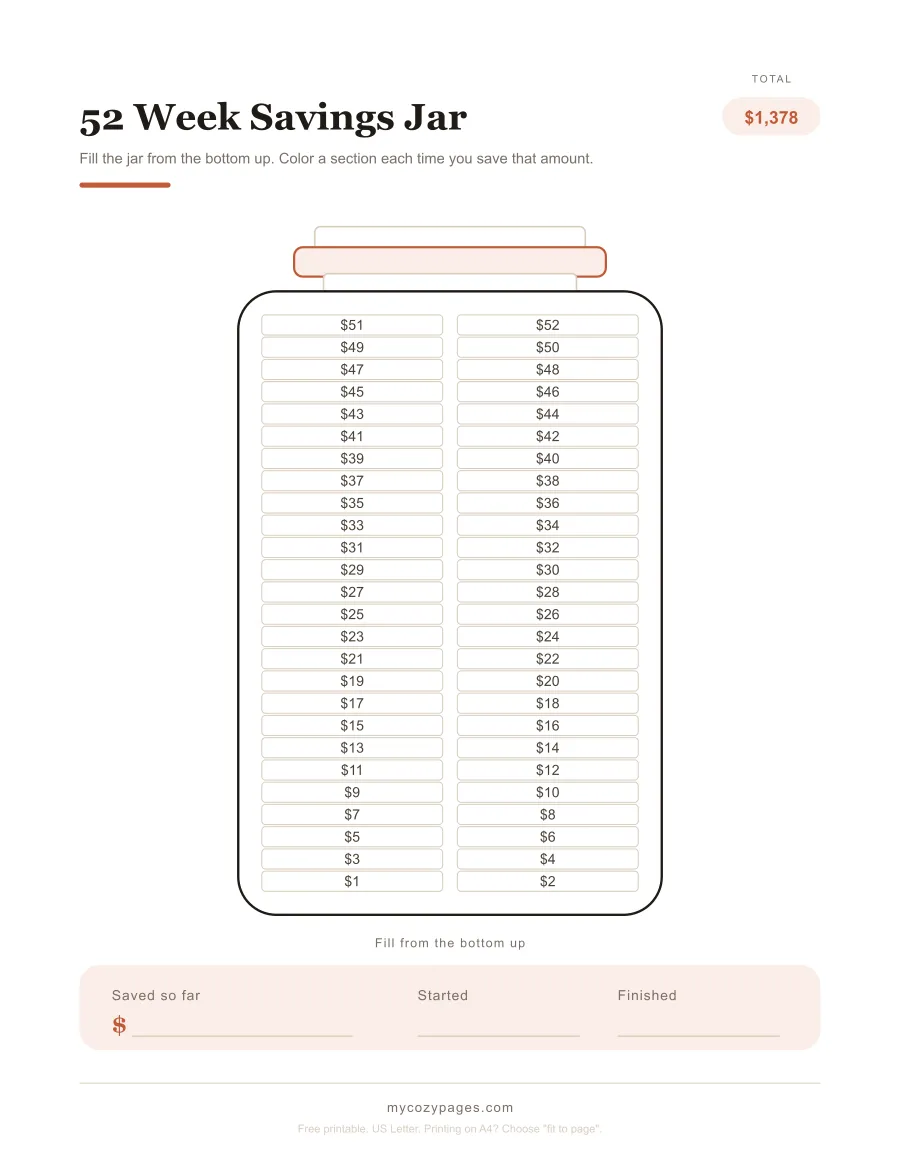
A jar split into 52 sections, one per week, filling from the bottom. Same $1,378, but you watch a level rise instead of crossing off a list.
- Total saved
- $1,378
- Deposits
- 52
- Biggest week
- $52
- Best for
- Watching the jar fill up rather than ticking a grid
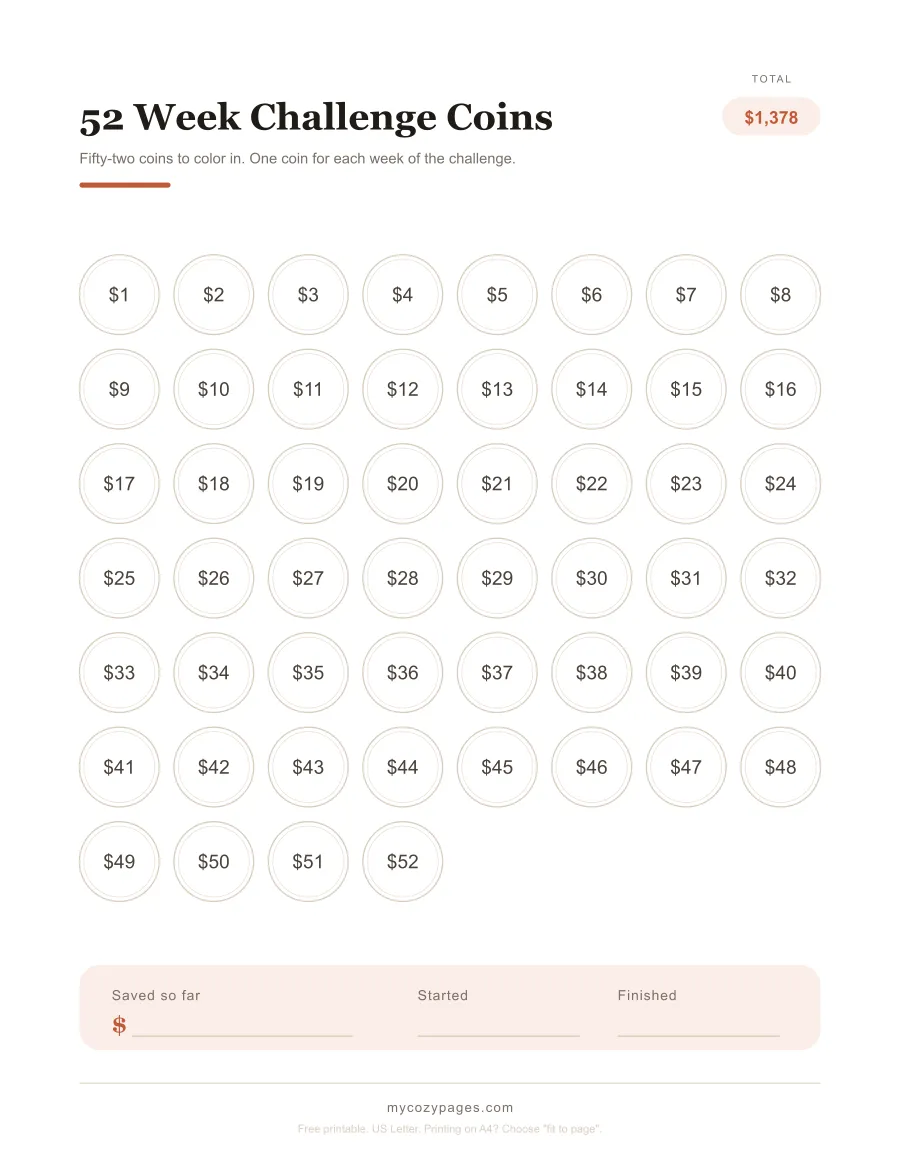
Coins Chart
Circles instead of squares, which makes it feel less like a spreadsheet. Fifty-two coins from $1 to $52, adding up to $1,378.
- Total saved
- $1,378
- Deposits
- 52
- Biggest week
- $52
- Best for
- Kids, and anyone who finds circles more satisfying than squares
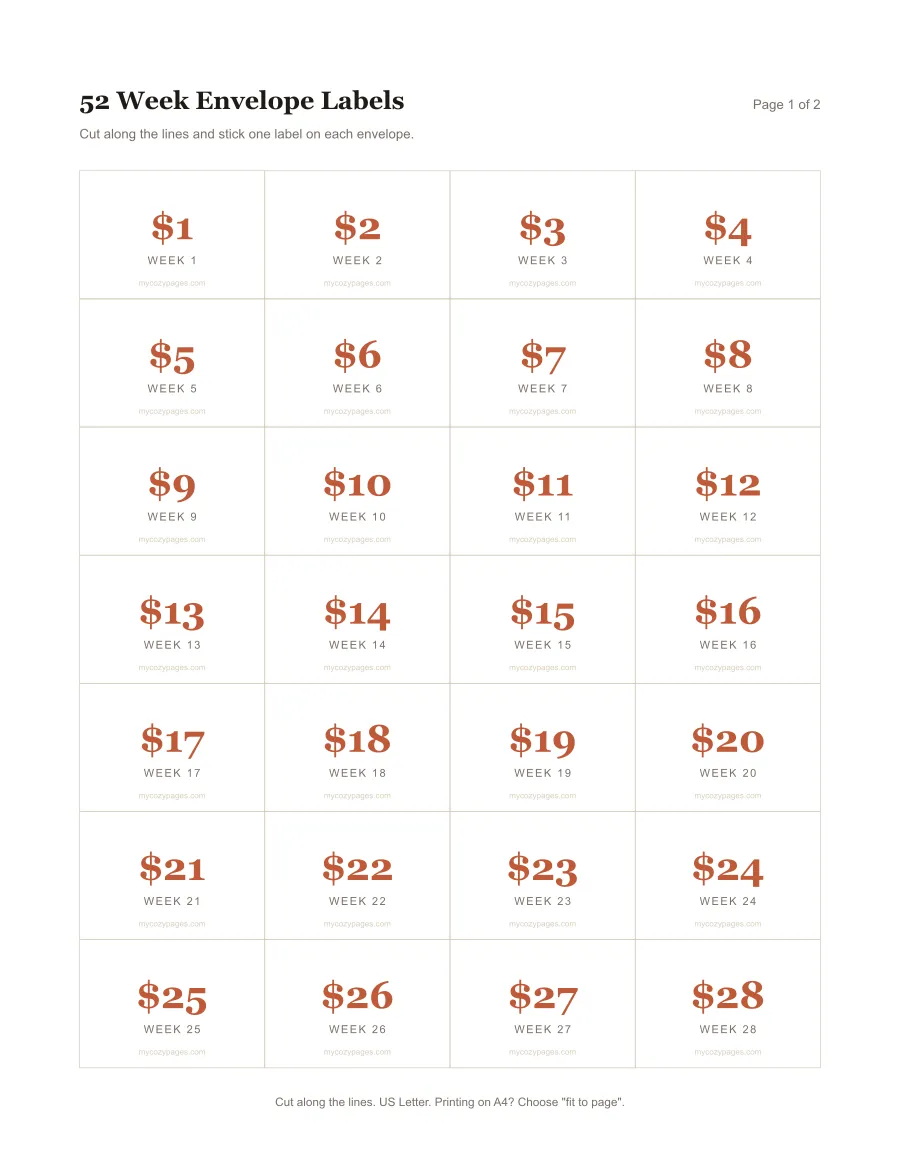
Envelope Labels
Fifty-two labels, $1 to $52, twenty-eight to a page with cut lines. Stick one on each envelope, then fill them as the weeks go by.
- Total saved
- $1,378
- Deposits
- 52
- Biggest week
- $52
- Best for
- Doing the challenge with cash envelopes
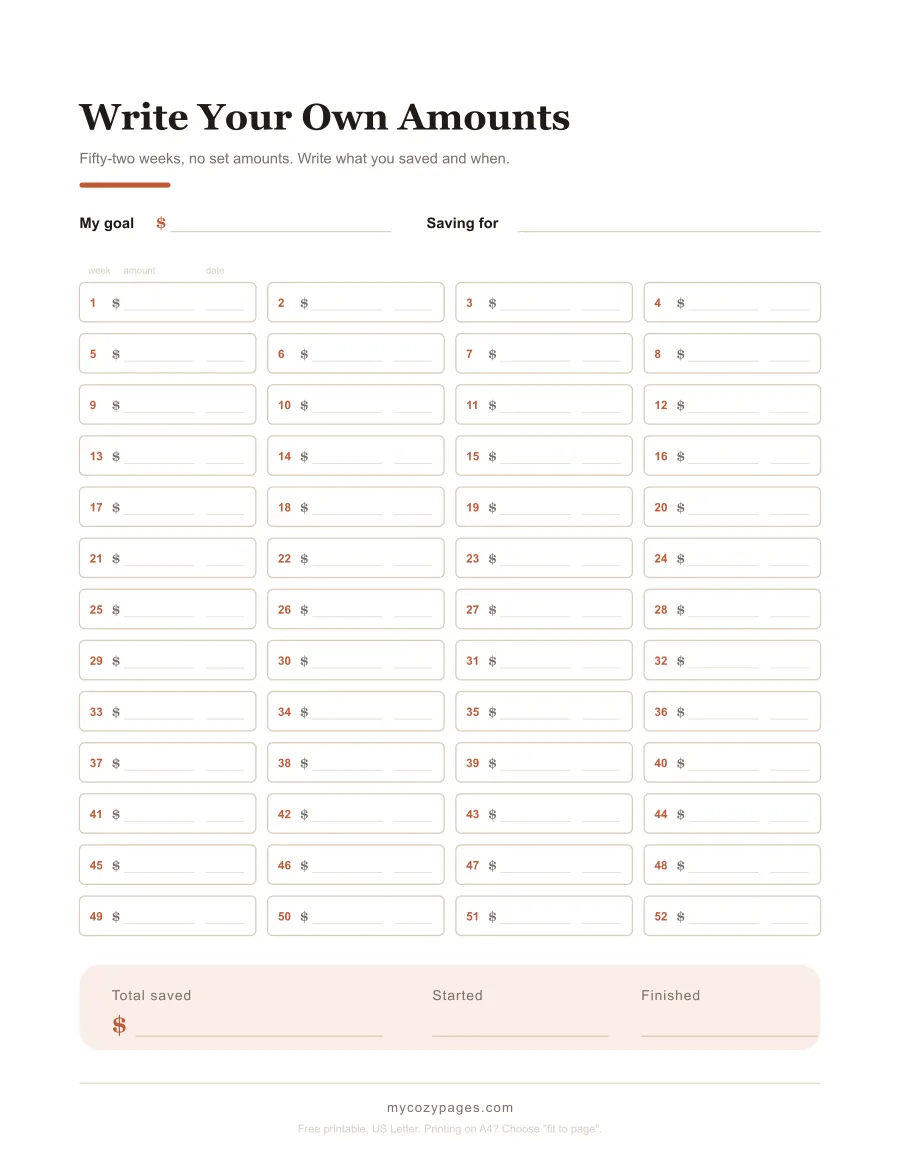
Write Your Own Amounts
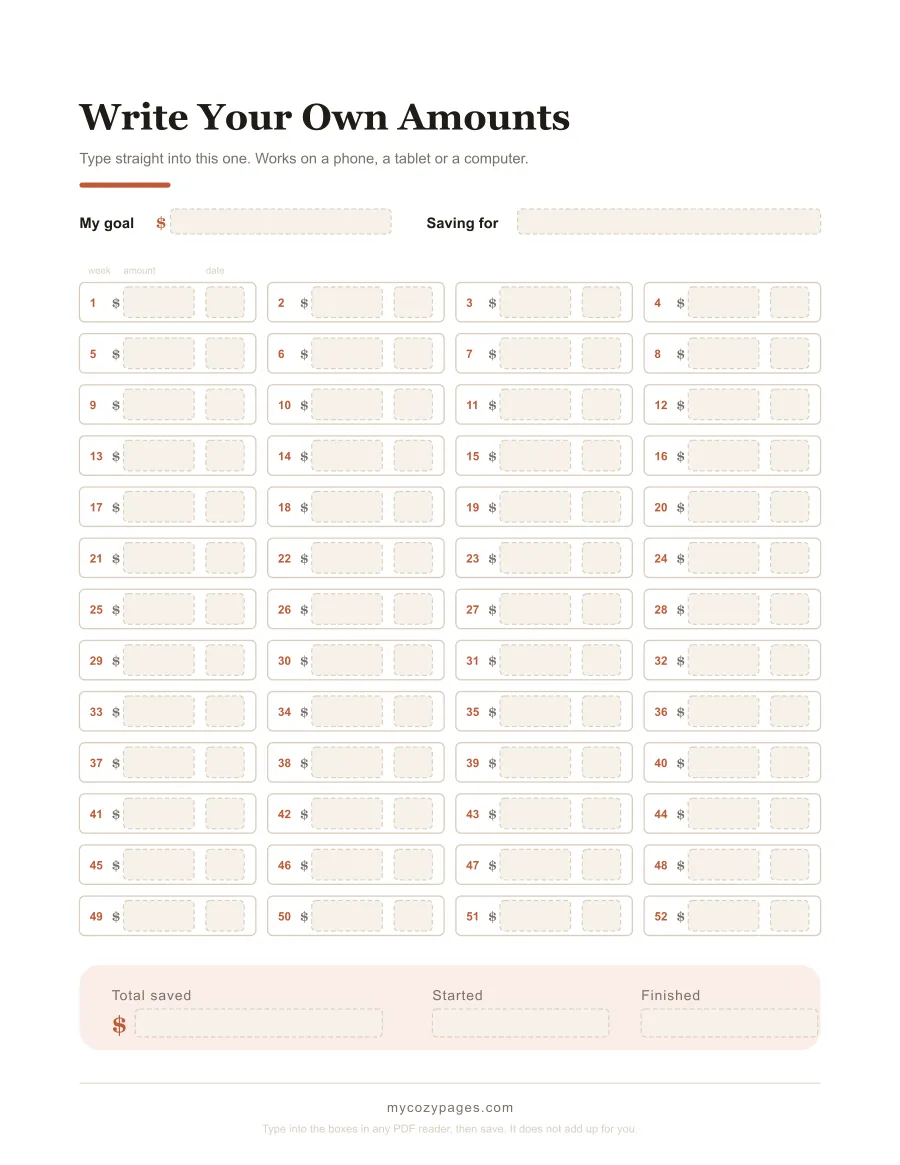
The same 52 boxes with the amounts left out. Write in whatever you managed that week and the date you did it. There is no schedule, so there is nothing to fall behind on.
- Total saved
- You decide
- Deposits
- 52
- Biggest week
- Your choice
- Best for
- Irregular income, where a fixed schedule never survives real life
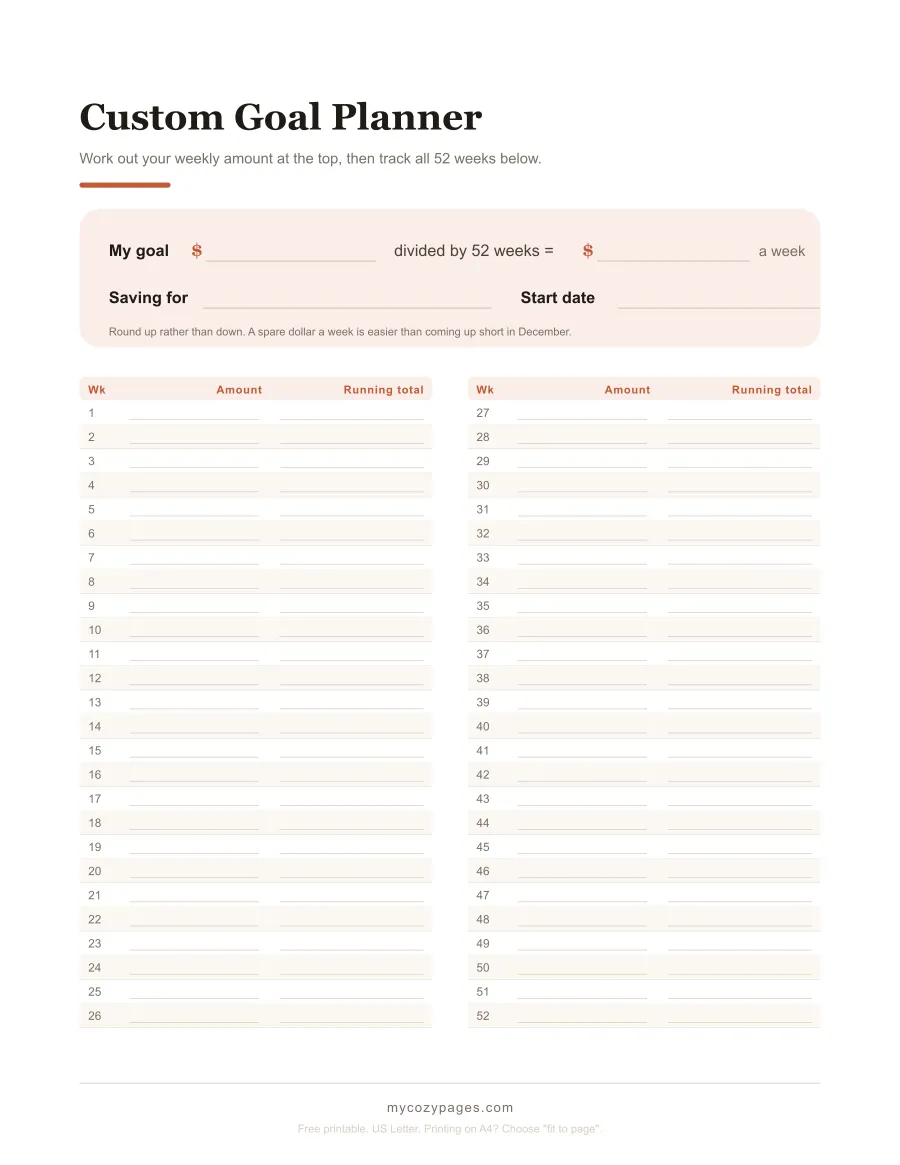
Custom Goal Planner
Start from the goal instead of the schedule. Divide what you need by 52, write it at the top, then fill in the amount and the running total each week.
- Total saved
- You decide
- Deposits
- 52
- Biggest week
- Your choice
- Best for
- Working back from a number you actually need
Fillable Chart
The write-in chart with real form fields, so you can type into it in any normal PDF reader and save it. It does not add up for you, because too many PDF apps ignore calculations, but every box is typeable.
- Total saved
- You decide
- Deposits
- 52
- Biggest week
- Your choice
- Best for
- Filling in on a phone or tablet instead of printing
Versions compared
| Version | Deposits | Biggest week | Total |
|---|---|---|---|
| Classic | 52 | $52 | $1,378 |
| Reverse | 52 | $52 | $1,378 |
| 2027 dated | 52 | $52 | $1,378 |
| Blank dates | 52 | $52 | $1,378 |
| $2 | 52 | $104 | $2,756 |
| $5 | 52 | $260 | $6,890 |
| $10 | 52 | $520 | $13,780 |
| Biweekly | 26 | $103 | $1,378 |
| Kids | 52 | $13 | $344.50 |
| Cozy color | 52 | $52 | $1,378 |
| Jar | 52 | $52 | $1,378 |
| Coins | 52 | $52 | $1,378 |
| Envelope labels | 52 | $52 | $1,378 |
| Write your own | 52 | Your choice | You decide |
| Goal planner | 52 | Your choice | You decide |
| Fillable | 52 | Your choice | You decide |
The totals are all arithmetic, not estimates. Each one is the sum of the amounts printed on that sheet.
Make it your own
Three of the sixteen have no amounts printed on them at all, which suits anyone the fixed schedule does not.
Write Your Own Amounts is the plain version: 52 boxes, a space for the amount and a space for the date, and a goal line at the top. It is the one to take if your income moves around. A quiet week costs you a small number rather than a broken streak, because there is no number you were supposed to hit.
Custom Goal Planner starts from the other end. You write what you need at the top, divide it by 52, and that is your weekly amount. Then there are 52 rows with a column for what you put in and a column for the running total. Use this one when you are saving for something specific with a price on it.
Fillable Chart is the write-in sheet with real form fields, so you can type into it on a phone, a tablet or a computer and save it without printing anything. It does not add up for you. Too many PDF apps quietly ignore calculations, and a total that is sometimes wrong is worse than no total at all, so the running total stays yours to fill in.
The December problem
Here is the part almost nobody mentions. In the classic challenge, weeks 49 to 52 ask for $49, $50, $51 and $52. That is $202 in the last four weeks of the year, landing exactly when the holidays are already taking your money. On a January 1, 2027 start, the $52 week falls on Christmas Eve.
You have four ways out.
1. Run it in reverse. The reverse chart starts at $52 in January and finishes at $1 in late December. Same $1,378, but December costs you $10 instead of $202. This is the simplest fix and it is why the reverse version exists.
2. Fill the boxes out of order. Nothing on the sheet says you have to go left to right. Take the big boxes in the months when you have room and leave the small ones for December. The total is identical.
3. Pay December ahead in the summer. Color in weeks 49 to 52 during a quiet month when you have a little spare. By the time the holidays arrive, those four boxes are already done.
4. Pause and finish in January. Stop at week 48, which is $1,176, and finish the last four weeks in the new year. You end up with the same $1,378, just a few weeks later than planned. Nothing breaks.
Starting in 2027
If you want to start on January 1, 2027, the calendar is unusually tidy. January 1, 2027 falls on a Friday, so a Friday deposit schedule lines up with the first day of the year.
Two things worth knowing:
- The last deposit lands on Friday, December 24, 2027. The challenge finishes on Christmas Eve, which is either a nice bit of timing or the worst possible week to be handing over $52, depending on how your December looks.
- 2027 has 53 Fridays, because 365 days is 52 weeks plus one day, and that spare day is a Friday. December 31 is the extra one.
The 53rd Friday is not a problem. The challenge is 52 deposits, not a calendar year. You can treat the spare week as a buffer for one you missed, skip it entirely, or put in one more $52 and finish the year at $1,430.
The 2027 dated chart has all 52 dates printed on it, so you never have to work out which week you are on.
Starting late
You do not need January. The challenge is 52 weeks from whenever you start, not 52 weeks of one particular year.
- Starting in February or March? Use the blank date chart and write your own dates. You will finish in the same month next year.
- Starting mid-year? Same sheet. Starting in June means the expensive weeks land in April and May rather than December, which is arguably better.
- Want it done by Christmas anyway? Run the reverse version and fill boxes out of order, taking two small boxes some weeks to catch up.
- Only have a few months? The 52 week challenge is not the right shape. Take a sheet with no schedule on it instead, from the full list of savings challenges.
Where to keep the money
Anywhere that is not your everyday checking account. A separate savings account with no debit card attached works well, and a cash envelope or jar works too if you prefer paper money.
The savings challenge guide goes into this in more detail.
What if you miss a week?
Almost everyone does. Missing a week is not the end of the challenge, and you do not start over.
Color the box in late, or take a smaller box that week and come back to the big one. If you are several weeks behind, catch up with one larger payment when a refund or a bonus turns up. The total only depends on every box being filled once, not on the order or the timing.
If the amounts have simply become too big, switch to the kids version or the biweekly chart and carry over what you have already saved. Changing the plan is not quitting.
A note before you start
These printables are organizing tools, not financial advice. They do not know your income, your bills or your situation, and filling one in does not guarantee any particular result. If you are weighing saving against paying off a debt, or you want advice about your own money, please talk to a qualified professional.
Print the chart, save what you can, color the box.
Looking for something other than the 52 week challenge? The full savings challenge guide has eleven of them, including the 100 envelope challenge and a penny challenge that starts at one cent.
Save it for later
Free 52 week savings challenge printables. Sixteen charts in one PDF: classic, reverse, biweekly, dated for 2027, a savings jar, coins, envelope labels and a fillable version. Save $1,378 in a year, or write in your own amounts. US Letter, light on ink, no email needed.
Save this pinFrequently asked questions
How much do you save with the 52 week challenge?
Exactly $1,378. You save $1 in week one, $2 in week two, and so on up to $52 in the final week. Add the 52 amounts together and you get $1,378.
How much will I have saved after 6 months?
$351 after 26 weeks, which is about a quarter of the total. The amounts are small early on, so the second half of the year does most of the work.
What happens in a year with 53 weeks, like 2027?
Nothing changes. The challenge is 52 deposits, not a full calendar year. Starting Friday January 1, 2027, the last deposit falls on Friday December 24 and December 31 is a spare week. Use it as a buffer, skip it, or add one more $52.
Is the reverse challenge easier?
Not overall, but it is easier in December. Both versions total $1,378. The reverse puts the large amounts in January, when most people have more room, and leaves $1 to $4 for the holidays.
What if I miss a week?
Fill it in later or take a smaller box instead. Nothing says you have to go in order. The total only depends on filling every box once, not on when you do it.
Can I do the 52 week challenge with $5 instead of $1?
Yes, and it totals $6,890. The $5 version multiplies every amount by five, so week 52 asks for $260. There is a $2 version at $2,756 and a $10 version at $13,780 on this page too.
Can I do the 52 week challenge with cash envelopes?
Yes. Label 52 envelopes $1 to $52, and put that amount of cash in one envelope each week. The chart works as the tracker, so you color in the box once the envelope is filled.
Can kids do the 52 week challenge?
Yes, with the quarters version. It runs from one quarter in week one to $13 in week 52 and totals $344.50, which is small enough for pocket money.
This printable is part of our guide to 11 Free Printable Savings Challenges (PDF).
Get the free starter kit
An optional bundle sent by email: a budget sheet, a bill tracker and a savings challenge to get you started. Every printable on the site stays free to download without it.
Unsubscribe any time. No spam, ever.